
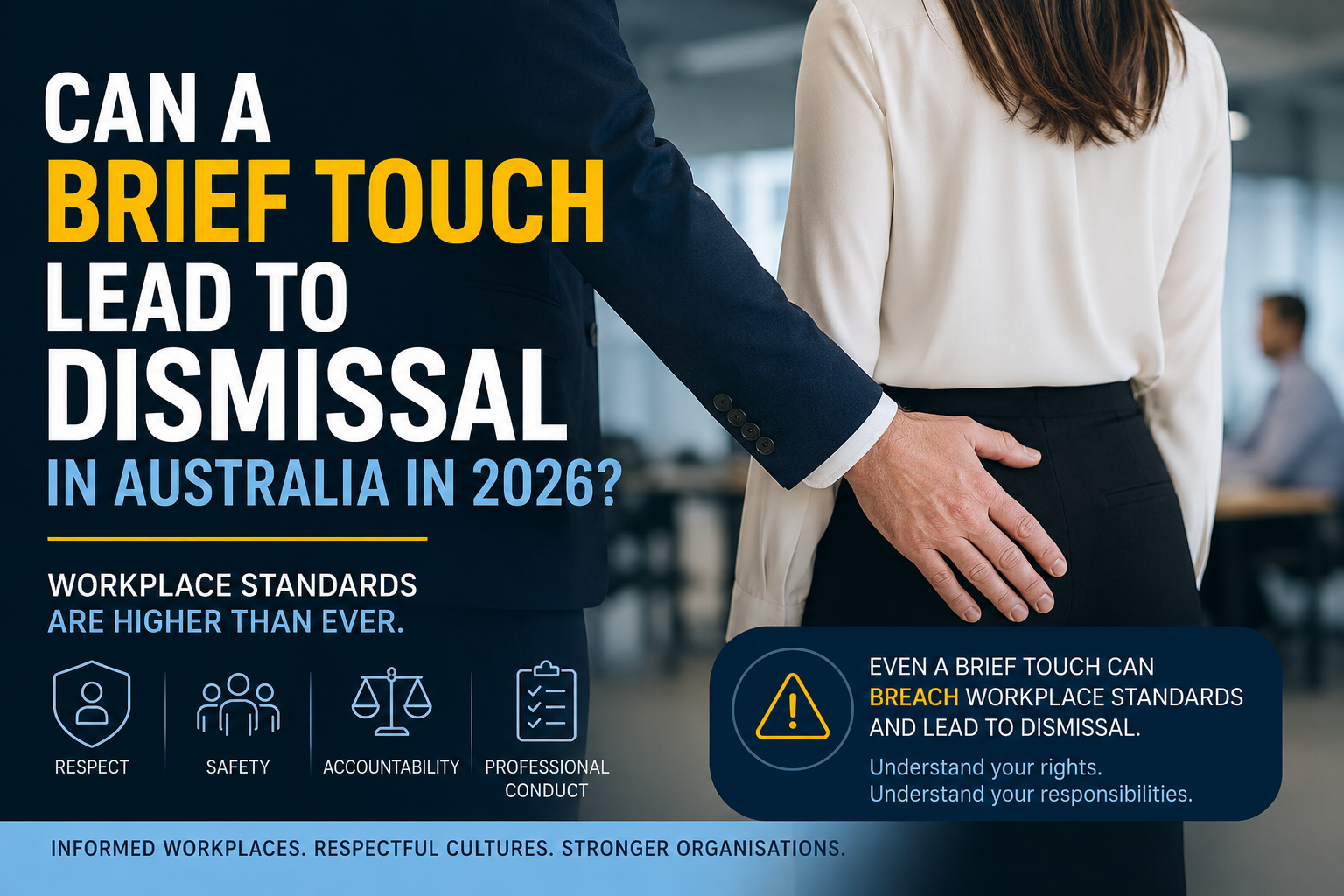
Can a Brief Touch Still Lead to Dismissal in Australia in 2026?

Can a Brief Touch Still Lead to Dismissal in Australia in 2026?

Many employees still believe that a brief physical interaction at work — a touch on the back, shoulder, waist or even buttocks — is unlikely to justify dismissal.

That assumption is increasingly risky.

Australian workplaces in 2026 operate under far stricter expectations concerning workplace behaviour, sexual harassment and psychological safety. Employers now face significant legal obligations to prevent inappropriate conduct, and tribunals are applying modern community standards when assessing workplace misconduct.

One Fair Work Commission decision that continues to influence employers and investigators is John Keron v Westpac Banking Corporation [2022] FWC 221. (DWF)

The decision sends a clear message:

Even a brief intentional touch can justify dismissal if it breaches workplace standards and undermines workplace safety and respect.

The attached draft article provided an excellent foundation for this discussion.

The Westpac Decision Still Matters in 2026

The case involved a senior Westpac manager with more than 35 years of otherwise unblemished service. After a compulsory professional development workshop, employees attended a work-related social gathering at a hotel venue.

Later in the evening, CCTV captured the employee placing his hand on a female colleague’s lower buttocks and moving it upwards toward her waist. Westpac conducted an internal investigation and terminated his employment for serious misconduct. The employee then challenged the dismissal in the Fair Work Commission.

Deputy President Binet upheld the dismissal. (DWF)

Importantly, the Commission acknowledged that community expectations regarding consent and workplace conduct had significantly changed.

The Commission stated:

“The bar as to what constitutes consent for physical and sexual interactions has been significantly raised in the broader community.” (DWF)

That observation remains highly relevant in 2026.

“It Was Only a Joke” No Longer Provides Protection

Historically, some workplace behaviour was minimised as “banter”, “harmless fun” or “nothing serious”.

Australian employers can no longer afford to adopt that approach.

The introduction of positive duties under anti-discrimination legislation, increased psychosocial safety obligations under work health and safety laws, and heightened public awareness following national workplace harassment inquiries have fundamentally shifted employer expectations.

Today, employers must actively prevent inappropriate conduct, not merely respond after the damage occurs.

That includes:

  • unwanted touching;
  • sexually suggestive conduct;
  • inappropriate jokes;
  • physical familiarity;
  • after-hours misconduct connected to work; and
  • behaviour occurring at conferences, Christmas parties or networking events.

The key issue is not whether the employee intended harm.

The key question is whether the conduct was unwelcome and whether it breached workplace standards.

Work Functions Are Still Workplaces

One of the most important aspects of the Keron decision involved the Commission’s finding that the conduct remained sufficiently connected to employment even though it occurred after formal work activities had ended. (DWF)

Many employees wrongly assume workplace rules stop applying once alcohol is served or official hours finish.

They do not.

In 2026, employers routinely investigate conduct occurring at:

  • Christmas functions;
  • conferences;
  • interstate travel;
  • training programs;
  • networking events;
  • client dinners;
  • sporting events; and
  • informal after-work drinks.

If there is a sufficient connection to employment, disciplinary action may follow.

The Fair Work Commission has repeatedly confirmed that out-of-hours conduct may justify dismissal where the behaviour damages workplace relationships, creates safety risks or harms the employer’s reputation. (Holding Redlich)

Alcohol Is Not an Excuse

Alcohol continues to play a major role in workplace misconduct investigations.

However, intoxication rarely excuses inappropriate conduct.

In Keron, the Commission accepted the employee had consumed substantial alcohol but still concluded the conduct justified dismissal. (Holding Redlich)

In fact, intoxication may increase employer concerns because impaired judgment can heighten workplace safety and reputational risks.

Employers now regularly remind staff that workplace behaviour expectations continue to apply regardless of alcohol consumption.

Training and Policies Matter

Another critical issue in the Westpac matter involved workplace training.

The Commission noted that Westpac had provided training concerning sexual harassment, discrimination and workplace conduct shortly before the incident occurred. (DWF)

That significantly strengthened Westpac’s position.

The lesson for employers is clear.

Policies sitting unread on an intranet will not adequately protect an organisation.

Training must be:

  • regular;
  • practical;
  • contemporary;
  • scenario-based; and
  • actively reinforced by management.

Employees should clearly understand:

  • what constitutes inappropriate conduct;
  • how workplace standards apply at social events;
  • the consequences of misconduct; and
  • how complaints will be investigated.

This issue is particularly important for councils, government agencies and SMEs where informal workplace cultures sometimes blur professional boundaries.

Procedural Fairness Still Matters

Importantly, stronger expectations around workplace conduct do not remove the obligation for procedural fairness.

Employers must still conduct proper investigations before making disciplinary decisions.

A fair investigation should assess:

  • witness evidence;
  • CCTV or electronic evidence;
  • surrounding circumstances;
  • workplace policies;
  • credibility issues; and
  • whether the alleged conduct actually occurred.

Australian tribunals continue to criticise employers who rush investigations or predetermine outcomes.

Even where allegations involve sensitive conduct, employers must ensure investigations remain impartial, balanced and evidence-based.

The 2026 Reality

The modern workplace has changed.

Conduct once dismissed as “minor” can now result in serious disciplinary action, including termination of employment.

Employees should understand that brief physical contact may still breach workplace policies, particularly where the conduct is intimate, unwelcome or capable of causing discomfort.

For employers, the message is equally clear:

Strong workplace culture requires more than policies alone. It requires leadership, training, consistent enforcement and professionally conducted investigations.

Failing to act appropriately may expose organisations to:

  • unfair dismissal claims;
  • sexual harassment complaints;
  • workers compensation claims;
  • psychosocial hazard investigations;
  • reputational damage; and
  • regulatory scrutiny.

In 2026, Australian workplaces are expected to be respectful, psychologically safe and professionally managed.

Tribunals are making it increasingly clear that employers who enforce those standards reasonably and fairly will often receive strong legal support from the Fair Work Commission. (DWF)
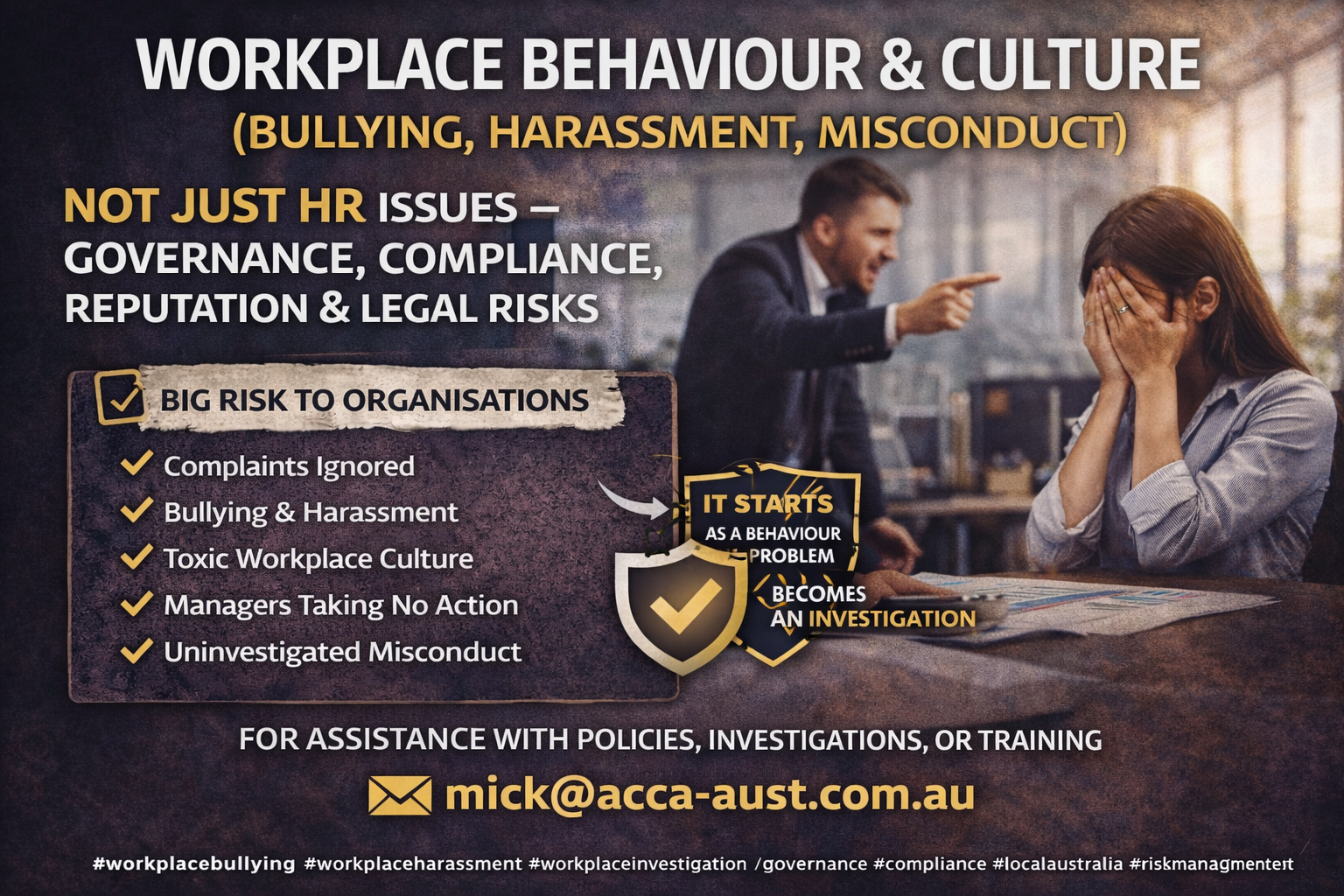
 

Workplace behaviour and culture

Bullying, Harassment, and Misconduct

Workplace behaviour and culture go far beyond being merely human resources concerns.

These concerns centre on governance, compliance, and risk management.

These issues directly affect governance, compliance, and risk management.

  • Formal complaints
  • Workplace investigations
  • Sick leave and workers’ compensation claims
  • Staff resignations
  • Unfair dismissal claims
  • Legal action
  • Reputational damage
  • Loss of productivity
  • Audit and governance issues

So workplace behaviour is a critical organizational risk—not just a personality issue.

What Exactly Defines Workplace Behaviour?

Workplace behaviour includes:

  • Bullying
  • Harassment
  • Sexual harassment
  • Discrimination
  • Aggressive management styles
  • Conflicts between staff
  • Inappropriate language
  • Misuse of authority
  • Misconduct
  • Breaches of the Code of Conduct
  • Victimisation
  • Unprofessional behaviour

These behaviours erode workplace culture and pose serious risks to the organization.

Why Workplace Culture Matters

Workplace culture is often described as:

“The way we do things around here.”

If the culture allows:

  • Bullying
  • Harassment
  • Aggressive behaviour
  • Poor management behaviour
  • Ignoring complaints
  • Favouritism
  • Conflicts of interest
  • Lack of accountability

Policies cannot resolve the issue because staff prioritise organizational culture over formal rules.

Toxic workplace culture often leads to:

  • High staff turnover
  • Increased sick leave
  • Low morale
  • Complaints
  • Investigations
  • Loss of staff
  • Difficulty recruiting staff
  • Reputational damage

Workplace culture is a governance matter, forged by the tone set from the top.

Bullying in the Workplace

Workplace bullying involves repeated unreasonable behaviour that threatens health and safety.

Examples include:

  • Yelling at staff
  • Constant criticism
  • Excluding staff
  • Setting unrealistic deadlines
  • Withholding information
  • Public humiliation
  • Threatening job loss
  • Excessive monitoring
  • Misuse of performance management
  • Spreading rumours

Bullying often escalates into both a WHS and HR issue.

Harassment and Sexual Harassment

Harassment encompasses any behaviour that:

  • Offends
  • Humiliates
  • Intimidates

Sexual harassment includes:

  • Unwelcome comments
  • Jokes
  • Messages
  • Emails
  • Physical contact
  • Requests for dates
  • Inappropriate comments
  • Displaying inappropriate material

Organizations now bear a proactive responsibility to prevent sexual harassment, not just respond to complaints.

Misconduct

Misconduct may include:

  • Breaches of the Code of Conduct
  • Inappropriate behaviour
  • Misuse of resources
  • Conflicts of interest
  • Fraud or theft
  • Breaches of policy
  • Failure to follow lawful and reasonable directions

Misconduct often sparks formal investigations.

Why These Issues Become Major Problems

Workplace behaviour issues can quickly escalate into major problems when:

  • Complaints are ignored
  • Managers do not act
  • Managers are the problem
  • There is no reporting system
  • Policies exist but are not followed
  • Investigations are not handled properly
  • There is no training
  • Leadership tolerates poor behaviour
  • There are no consequences

Many major workplace investigations stem from a minor issue that was first overlooked.

What Organizations Should Have in Place

To proactively manage workplace behaviour risks, Councils, and organizations should implement:

  • Code of Conduct
  • Workplace Behaviour Policy
  • Bullying and Harassment Policy
  • Complaint Handling Procedure
  • Investigation Procedure
  • Training for managers
  • Training for staff
  • External investigator available
  • Confidential reporting process
  • Proper documentation
  • Leadership training
  • Clear consequences for misconduct

This forms a key part of a strong compliance and governance framework.

The Role of Managers and Leaders

Managers and leaders shape workplace culture in important and impactful ways.

Staff closely watch how managers act and what they allow.

When managers:

  • Ignore bad behaviour
  • Do not act on complaints
  • Play favourites
  • Bully staff
  • Do not follow policy
  • Do not document issues

As a result, the workplace culture will deteriorate.

Culture Flows Powerfully from the Top Down.

Final Thought

Many organizations see workplace behaviour issues as solely the responsibility of Human Resources.

They are not.

These issues touch on governance, risk management, legal matters, and reputation.

If workplace behaviour is not managed effectively, it will inevitably become:

  • A complaint
  • An investigation
  • A legal issue
  • A reputational issue

A powerful way to manage workplace behaviour is to:

  • Set clear standards
  • Train staff and managers
  • Act on issues early
  • Investigate properly
  • Ensure leadership sets the right example

Remember

Workplace culture springs from influences that go far beyond formal policies.

It is shaped by the behaviour you allow.

Contact [email protected] if you need help in this area.

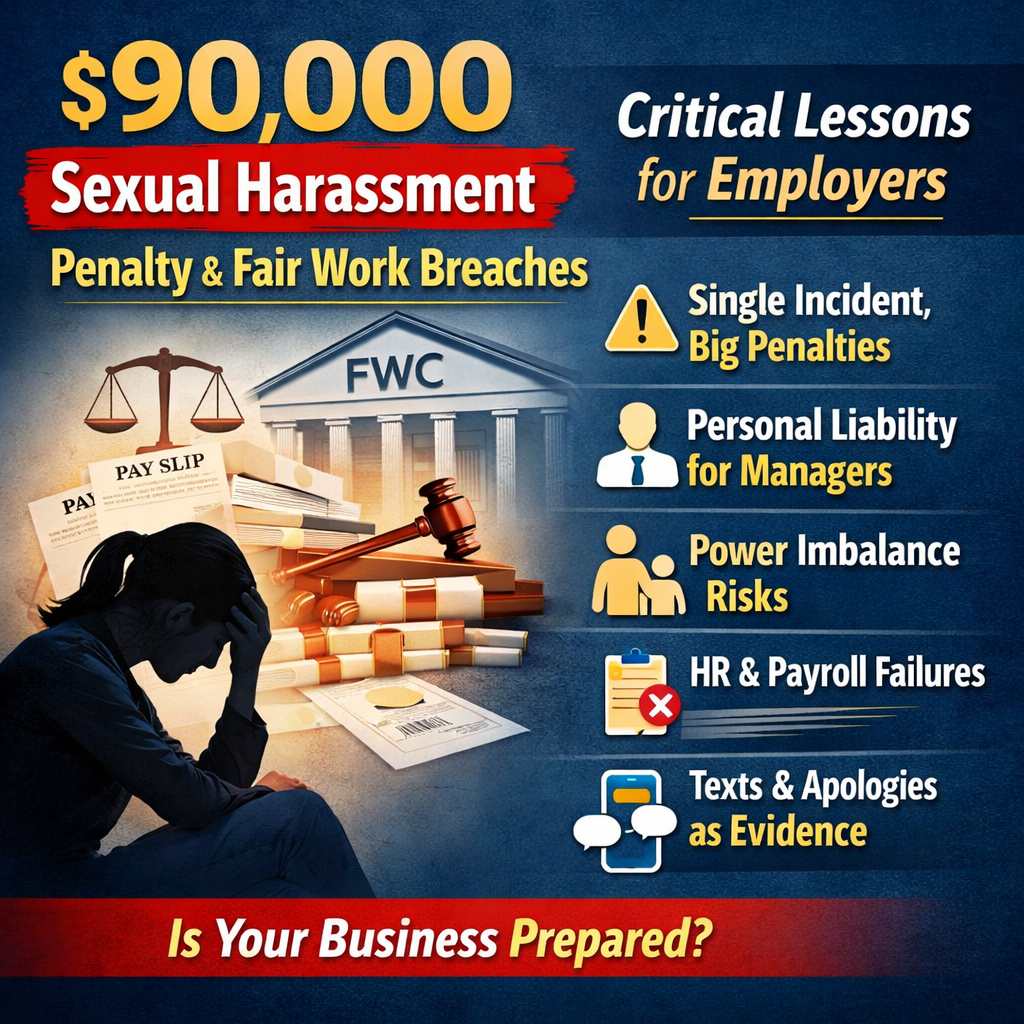
$90,000 Sexual Harassment Case: A Warning for Councils and Small Businesses

Sexual harassment penalty $90,000 Fair Work breaches – lessons for employers on liability, HR failures, and workplace compliance in Australia.

$90,000 Sexual Harassment Case: A Warning for Councils and Small Businesses


$90,000 Sexual Harassment Decision – What Council CEOs and SME Managers Must Learn From This Case

A recent Federal Circuit and Family Court decision has sent a very clear message to employers across Australia: failing to properly manage workplace sexual harassment and basic employment obligations can be extremely costly — both financially and reputationally.

In Mejia v Capital City Café-Bar [2026], the Court ordered a café director to pay approximately $90,000 in compensation and penalties following a sexual harassment incident involving a young employee. This case is significant because it is one of the first published decisions under the new sexual harassment jurisdiction introduced under the Fair Work Act reforms in March 2023.

For Council CEOs, senior managers, and SME owners, this case provides several critical lessons.

What Happened in This Case?

The employee, a 23-year-old migrant worker, alleged that the café director hugged her, kissed her without consent, and attempted to offer her money while pinning her against a sink.

The incident occurred shortly after the employee had raised concerns about her pay and the fact that she had not been receiving pay slips. The employee did not return to work after the incident and later commenced legal proceedings.

The Court accepted that the incident caused distress, humiliation, and ongoing emotional impact, and compensation was awarded accordingly.

However, the sexual harassment itself was only part of the problem.

The Employer’s Bigger Problem – Multiple Fair Work Breaches

What significantly increased the penalties was the employer’s broader failure to comply with basic employment laws. The Court found the director had failed to:

  • Provide a Fair Work Information Statement
  • Provide a Casual Employment Information Statement
  • Provide pay slips
  • Pay correct wages including overtime and casual loading
  • Maintain proper employment records
  • Make the Award and National Employment Standards available
  • Provided false pay slips to the Fair Work Ombudsman

The Judge described this as a “comprehensive, if not complete, disregard for the obligations of a national system employer.”

This is a critical point for employers: sexual harassment cases often expose broader compliance failures.

Important Legal Development – New Sexual Harassment Jurisdiction

This case was brought under section 527D of the Fair Work Act, introduced under the Secure Jobs, Better Pay reforms.

This means employees now have another legal pathway to pursue sexual harassment claims — in addition to the Human Rights Commission and anti-discrimination processes.

In practical terms, this increases the legal risk for employers.

Key Takeaways for Council CEOs and SME Managers

  1. A Single Incident Can Result in Large Compensation

The Court made it clear that sexual harassment does not need to be repeated behaviour to result in significant damages.

Many managers still believe that a “one-off incident” is less serious.
This case confirms that is not how courts see it.

  1. Power Imbalance Matters

The Court placed significant weight on:

  • The employee being young
  • Being a migrant
  • Having limited financial resources
  • The offender being the business owner and in a position of authority

This highlights a major risk area for:

  • Small businesses
  • Councils
  • Family-run businesses
  • Workplaces where owners/directors deal directly with staff

Power imbalance increases damages.

  1. Poor HR Practices Will Make Everything Worse

The penalties were not just for harassment — they were for systemic non-compliance.

This is where many councils and SMEs are exposed:

  • No proper policies
  • No training
  • Poor documentation
  • Incorrect pay slips
  • No investigation procedures
  • No HR systems
  • No external investigator

When something goes wrong, these failures compound liability.

  1. Text Messages and Apologies Can Become Evidence

The director sent messages apologising and asking the employee to keep the incident secret.

This significantly damaged his case.

Managers and business owners often try to “fix things informally” after an incident.
This can make the legal situation worse.

  1. This Case Sends a Message About Personal Liability

Importantly, the director personally was ordered to pay penalties.

This is critical for:

  • Council senior managers
  • Directors
  • Business owners
  • CEOs
  • General Managers

You can be personally liable, not just the organisation.

What Organisations Should Do Now

This case clearly shows what organisations should have in place:

  1. A clear sexual harassment policy
  2. Complaint reporting procedures
  3. Investigation procedures
  4. Manager training
  5. Proper wage and payroll compliance
  6. Proper employment records
  7. Access to an external investigator
  8. Post-investigation follow-up processes

Organisations that do not have these systems are exposed to significant risk.

Final Thoughts

This decision is a warning to employers across Australia. The combination of sexual harassment and basic employment law breaches resulted in a $90,000 outcome for a single incident involving one employee in a small business.

For councils and SMEs, the message is very clear:

If you do not have proper workplace policies, complaint procedures, and investigation processes in place before something happens, it is already too late.

Prevention, proper procedures, and independent investigations are no longer optional — they are a critical part of risk management and governance.

If you have none of these, then contact ACCA ([email protected]). I can help protect you, your business, and your employees by ensuring you have the proper policies and ensuring matters are handled properly, fairly, and legally.

FREE Fraud Health Check for Small Businesses

Think you might be the Victim of Fraud? 

Fill out the form below to get sent our free survey that provides you with an indication of the potential vulnerability of your business to fraudulent activities.

    FREE Fraud Health Check for Businesses

    Think you might be the Victim of Fraud? 

    Fill out the form below to get sent our free survey that provides you with an indication of the potential vulnerability of your business to fraudulent activities.