
Bullying and Harrasment
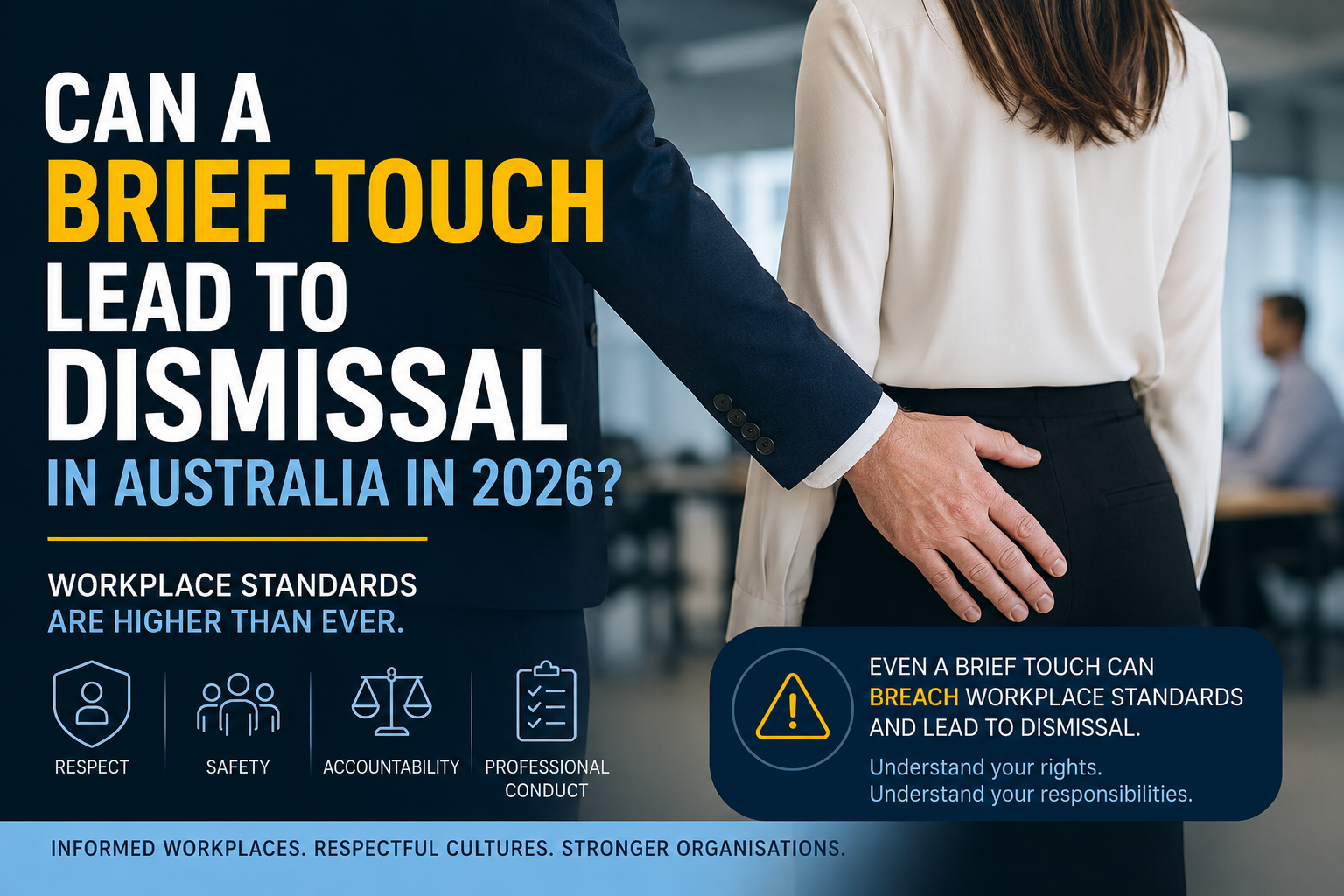
Workplace Bullying Prevention Australia: Why Councils and SMEs Must Act Before Problems Escalate
by Mick Symons

Workplace Bullying Prevention Australia: Why Councils and SMEs Must Act Before Problems Escalate
Workplace bullying continues to challenge Australian organisations despite years of focus on workplace culture, employee wellbeing and compliance. Councils and small to medium-sized businesses (SMEs) regularly deal with the consequences of bullying complaints, including workplace investigations, staff turnover, workers’ compensation claims, damaged morale, and reputational harm.
Many organisations still view workplace bullying as an employee relations issue. That approach is no longer sufficient.
In 2026, regulators increasingly treat workplace bullying as a psychosocial hazard that employers must actively manage under workplace health and safety obligations. Organisations that ignore the warning signs expose themselves to significant legal, financial, and operational risks.
The reality is straightforward. Preventing workplace bullying costs far less than dealing with the fallout.
Why Workplace Bullying Matters More Than Ever
Workplace bullying affects far more than the individuals directly involved. It can undermine workplace culture, damage productivity, and create lasting impacts across entire teams.
When employees experience bullying, organisations often see:
- Increased absenteeism.
- Higher staff turnover.
- Reduced productivity.
- Lower employee engagement.
- Workplace conflict.
- Workers’ compensation claims.
- Costly workplace investigations.
For councils, the risks can be even greater. Allegations involving senior managers, executives or elected members can quickly attract media attention and erode community confidence.
For SMEs, the loss of a valued employee or a prolonged workplace dispute can significantly disrupt day-to-day operations.
What Is Workplace Bullying?
Workplace bullying occurs when a person or group repeatedly behaves unreasonably towards a worker or group of workers in a way that creates a risk to health and safety.
The key elements are repetition, unreasonable behaviour, and risk.
Bullying may involve:
- Repeated verbal abuse.
- Intimidation or aggressive behaviour.
- Persistent humiliation.
- Deliberately excluding individuals from workplace activities.
- Spreading rumours or gossip.
- Unreasonable workloads or deadlines.
- Withholding information necessary to perform duties.
- Harassment through emails, messaging applications or social media.
Although a single incident may not constitute workplace bullying, employers should never ignore inappropriate behaviour. Early intervention often prevents minor issues from developing into formal complaints or workplace investigations.
Workplace Bullying Is Now a Psychosocial Hazard
Australian workplaces have experienced a significant shift in how they manage employee wellbeing.
Employers are now expected to identify and manage psychosocial hazards with the same diligence they apply to physical hazards. Workplace bullying remains one of the most common and damaging psychosocial risks.
Unchecked bullying can contribute to:
- Anxiety and depression.
- Stress-related illness.
- Reduced workplace participation.
- Long-term psychological injury.
- Increased workers’ compensation costs.
The impact often extends beyond the affected employee. Teams experiencing unresolved conflict frequently suffer declining morale, reduced collaboration, and poorer performance.
Organisations that actively manage psychosocial risks are better positioned to create safe, productive, and compliant workplaces.
The Hidden Cost of Workplace Bullying
Many organisations underestimate the true cost of workplace bullying.
The direct expenses associated with complaints often include legal advice, investigations, and compensation claims. However, the indirect costs frequently exceed the visible financial impacts.
These costs may include:
- Internal investigations.
- Independent workplace investigations.
- Legal representation.
- Recruitment and onboarding expenses.
- Lost productivity.
- Increased sick leave.
- Reduced employee engagement.
- Damage to organisational reputation.
Every bullying complaint consumes management time and organisational resources. The longer issues remain unresolved, the more expensive they become.
Why Councils Face Unique Risks
Local government operates in an environment where transparency, accountability and public trust are essential.
Unlike private sector organisations, councils must manage workplace issues while maintaining public confidence and responding to community expectations.
Poorly managed workplace bullying complaints can result in:
- Governance reviews.
- Community criticism.
- Political pressure.
- Adverse media coverage.
- Reputational damage.
A complaint that begins as an internal employment matter can quickly become a public issue.
That reality makes early intervention and effective workplace culture management critical for councils of all sizes.
Leadership Shapes Workplace Culture
Strong leadership remains the most effective defence against workplace bullying.
Employees closely observe how leaders behave and what behaviour they tolerate. Managers who ignore inappropriate conduct often create an environment where bullying flourishes.
Leaders who consistently demonstrate professionalism, accountability and respect set a very different standard.
Effective leaders:
- Address concerns promptly.
- Communicate expectations clearly.
- Support respectful workplace behaviour.
- Hold individuals accountable.
- Promote psychological safety.
Organisations rarely regret acting too early. They often regret acting too late.
Policies Alone Will Not Prevent Bullying
Every organisation should maintain a clear workplace bullying policy. However, policies only work when employees understand them, and leaders apply them consistently.
An effective policy should:
- Define workplace bullying.
- Provide practical examples.
- Explain reporting pathways.
- Outline investigation procedures.
- Emphasise procedural fairness.
- Explain confidentiality obligations.
- Identify available support services.
A policy hidden on an intranet page will not change workplace behaviour.
Employees need confidence that leaders will enforce the policy fairly and consistently.
Training Builds Capability and Accountability
Workplace bullying prevention requires ongoing education.
Employees need to understand what bullying looks like, how to report concerns and what standards of behaviour the organisation expects.
Managers require additional skills in:
- Complaint management.
- Conflict resolution.
- Difficult conversations.
- Psychosocial risk management.
- Early intervention strategies.
- Workplace investigations.
Regular training helps organisations reinforce expectations and maintain a respectful workplace culture.
Early Intervention Prevents Escalation
Most serious workplace disputes begin with relatively minor issues that organisations fail to address.
Common warning signs include:
- Interpersonal conflict.
- Increased complaints.
- Team dysfunction.
- Employee disengagement.
- Declining morale.
- Increased absenteeism.
Managers who identify these indicators early can often resolve issues through coaching, mediation, facilitated discussions or other informal processes.
Early intervention remains one of the most effective workplace bullying prevention strategies available.
When Should You Engage an External Investigator?
Some matters require an independent assessment.
External workplace investigators may be appropriate when:
- Senior managers are involved.
- Conflicts of interest exist.
- Serious misconduct is alleged.
- Multiple parties are involved.
- Organisational impartiality may be questioned.
- Significant reputational risks exist.
An independent investigation helps demonstrate procedural fairness, transparency, and objectivity.
For councils, government agencies and larger SMEs, independent investigations often provide confidence to employees, executives, governing bodies, and the wider community.
Creating a Respectful Workplace Culture
Preventing workplace bullying requires more than policies, training sessions and investigations.
It requires leadership commitment and a workplace culture built on respect, accountability, and professionalism.
Organisations that encourage employees to raise concerns early, address complaints fairly and support respectful behaviour create safer and more productive workplaces.
The benefits are substantial:
- Stronger employee engagement.
- Higher retention rates.
- Better organisational performance.
- Reduced workplace conflict.
- Lower legal and compliance risks.
Final Thoughts
Workplace bullying is no longer simply an HR issue. It is a workplace health and safety issue, a governance issue, and a leadership issue.
Councils and SMEs that invest in workplace bullying prevention, psychosocial risk management, leadership development and workplace culture create stronger, safer, and more resilient organisations.
Those that delay action often face escalating conflict, costly investigations, reduced productivity, and reputational damage.
The most successful organisations understand a simple truth: preventing workplace bullying is not just about compliance. It is about protecting people, strengthening culture, and building a workplace where employees can perform at their best.
Workplace behaviour and culture
by Mick Symons
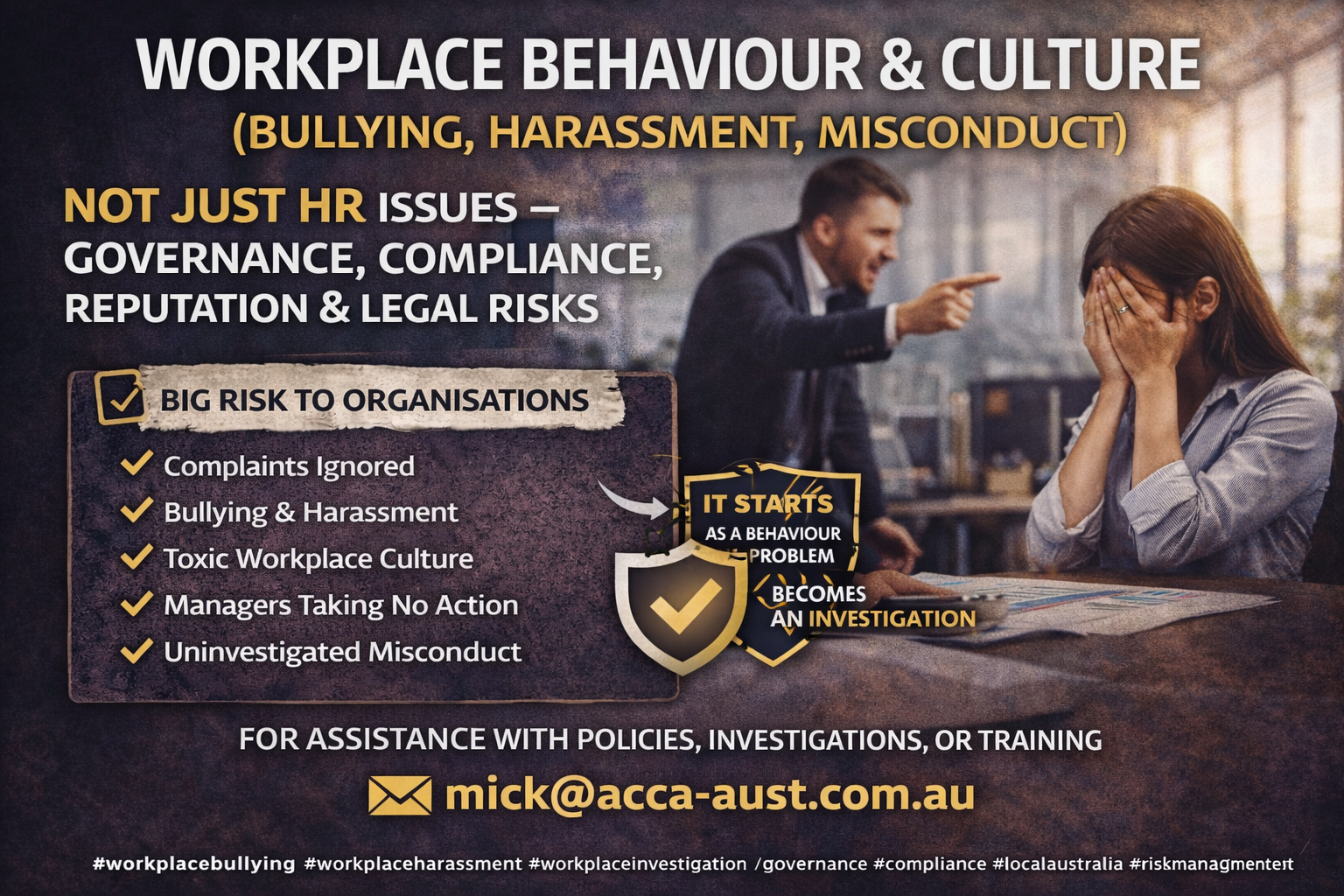
Bullying, Harassment, and Misconduct
Workplace behaviour and culture go far beyond being merely human resources concerns.
These concerns centre on governance, compliance, and risk management.
These issues directly affect governance, compliance, and risk management.
- Formal complaints
- Workplace investigations
- Sick leave and workers’ compensation claims
- Staff resignations
- Unfair dismissal claims
- Legal action
- Reputational damage
- Loss of productivity
- Audit and governance issues
So workplace behaviour is a critical organizational risk—not just a personality issue.
What Exactly Defines Workplace Behaviour?
Workplace behaviour includes:
- Bullying
- Harassment
- Sexual harassment
- Discrimination
- Aggressive management styles
- Conflicts between staff
- Inappropriate language
- Misuse of authority
- Misconduct
- Breaches of the Code of Conduct
- Victimisation
- Unprofessional behaviour
These behaviours erode workplace culture and pose serious risks to the organization.
Why Workplace Culture Matters
Workplace culture is often described as:
“The way we do things around here.”
If the culture allows:
- Bullying
- Harassment
- Aggressive behaviour
- Poor management behaviour
- Ignoring complaints
- Favouritism
- Conflicts of interest
- Lack of accountability
Policies cannot resolve the issue because staff prioritise organizational culture over formal rules.
Toxic workplace culture often leads to:
- High staff turnover
- Increased sick leave
- Low morale
- Complaints
- Investigations
- Loss of staff
- Difficulty recruiting staff
- Reputational damage
Workplace culture is a governance matter, forged by the tone set from the top.
Bullying in the Workplace
Workplace bullying involves repeated unreasonable behaviour that threatens health and safety.
Examples include:
- Yelling at staff
- Constant criticism
- Excluding staff
- Setting unrealistic deadlines
- Withholding information
- Public humiliation
- Threatening job loss
- Excessive monitoring
- Misuse of performance management
- Spreading rumours
Bullying often escalates into both a WHS and HR issue.
Harassment and Sexual Harassment
Harassment encompasses any behaviour that:
- Offends
- Humiliates
- Intimidates
Sexual harassment includes:
- Unwelcome comments
- Jokes
- Messages
- Emails
- Physical contact
- Requests for dates
- Inappropriate comments
- Displaying inappropriate material
Organizations now bear a proactive responsibility to prevent sexual harassment, not just respond to complaints.
Misconduct
Misconduct may include:
- Breaches of the Code of Conduct
- Inappropriate behaviour
- Misuse of resources
- Conflicts of interest
- Fraud or theft
- Breaches of policy
- Failure to follow lawful and reasonable directions
Misconduct often sparks formal investigations.
Why These Issues Become Major Problems
Workplace behaviour issues can quickly escalate into major problems when:
- Complaints are ignored
- Managers do not act
- Managers are the problem
- There is no reporting system
- Policies exist but are not followed
- Investigations are not handled properly
- There is no training
- Leadership tolerates poor behaviour
- There are no consequences
Many major workplace investigations stem from a minor issue that was first overlooked.
What Organizations Should Have in Place
To proactively manage workplace behaviour risks, Councils, and organizations should implement:
- Code of Conduct
- Workplace Behaviour Policy
- Bullying and Harassment Policy
- Complaint Handling Procedure
- Investigation Procedure
- Training for managers
- Training for staff
- External investigator available
- Confidential reporting process
- Proper documentation
- Leadership training
- Clear consequences for misconduct
This forms a key part of a strong compliance and governance framework.
The Role of Managers and Leaders
Managers and leaders shape workplace culture in important and impactful ways.
Staff closely watch how managers act and what they allow.
When managers:
- Ignore bad behaviour
- Do not act on complaints
- Play favourites
- Bully staff
- Do not follow policy
- Do not document issues
As a result, the workplace culture will deteriorate.
Culture Flows Powerfully from the Top Down.
Final Thought
Many organizations see workplace behaviour issues as solely the responsibility of Human Resources.
They are not.
These issues touch on governance, risk management, legal matters, and reputation.
If workplace behaviour is not managed effectively, it will inevitably become:
- A complaint
- An investigation
- A legal issue
- A reputational issue
A powerful way to manage workplace behaviour is to:
- Set clear standards
- Train staff and managers
- Act on issues early
- Investigate properly
- Ensure leadership sets the right example
Remember
Workplace culture springs from influences that go far beyond formal policies.
It is shaped by the behaviour you allow.
Contact [email protected] if you need help in this area.

$90,000 Sexual Harassment Case: A Warning for Councils and Small Businesses
by Mick Symons
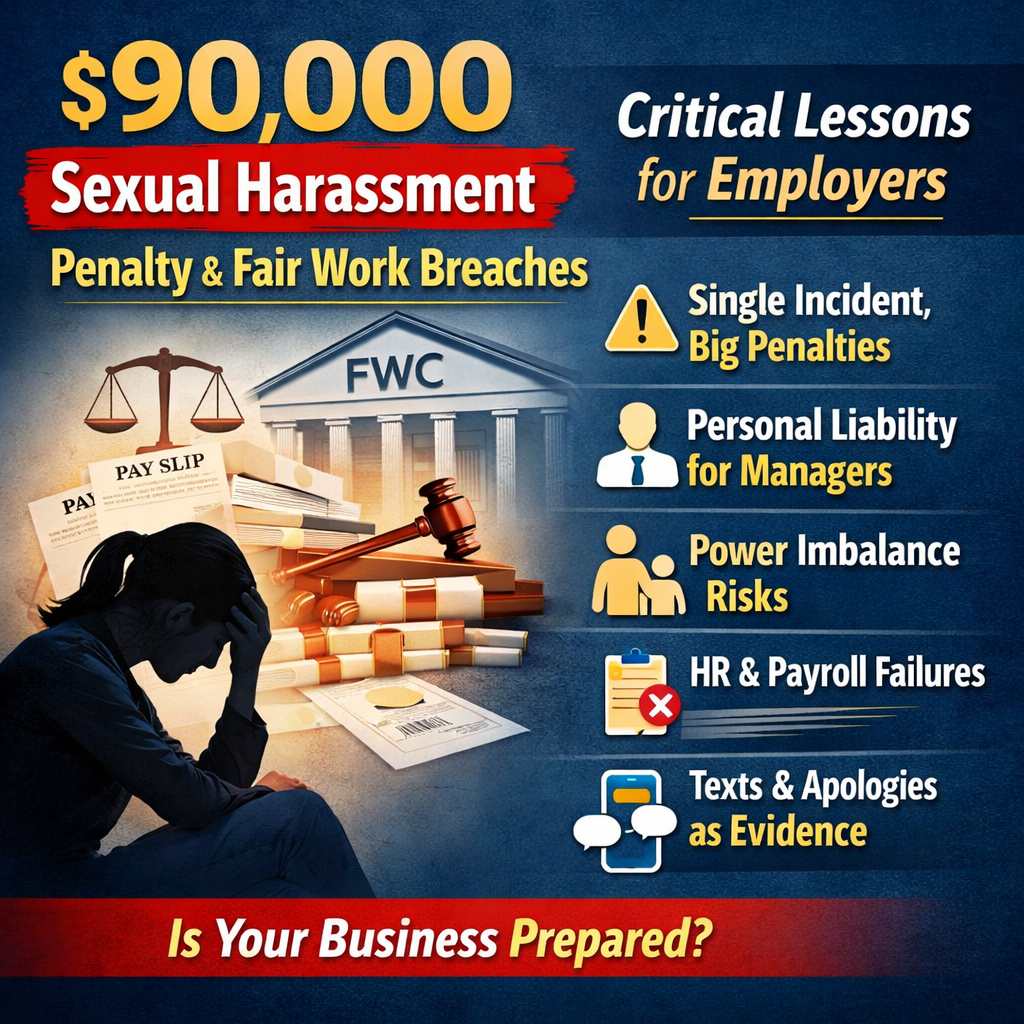
$90,000 Sexual Harassment Case: A Warning for Councils and Small Businesses
$90,000 Sexual Harassment Decision – What Council CEOs and SME Managers Must Learn From This Case
A recent Federal Circuit and Family Court decision has sent a very clear message to employers across Australia: failing to properly manage workplace sexual harassment and basic employment obligations can be extremely costly — both financially and reputationally.
In Mejia v Capital City Café-Bar [2026], the Court ordered a café director to pay approximately $90,000 in compensation and penalties following a sexual harassment incident involving a young employee. This case is significant because it is one of the first published decisions under the new sexual harassment jurisdiction introduced under the Fair Work Act reforms in March 2023.
For Council CEOs, senior managers, and SME owners, this case provides several critical lessons.
What Happened in This Case?
The employee, a 23-year-old migrant worker, alleged that the café director hugged her, kissed her without consent, and attempted to offer her money while pinning her against a sink.
The incident occurred shortly after the employee had raised concerns about her pay and the fact that she had not been receiving pay slips. The employee did not return to work after the incident and later commenced legal proceedings.
The Court accepted that the incident caused distress, humiliation, and ongoing emotional impact, and compensation was awarded accordingly.
However, the sexual harassment itself was only part of the problem.
The Employer’s Bigger Problem – Multiple Fair Work Breaches
What significantly increased the penalties was the employer’s broader failure to comply with basic employment laws. The Court found the director had failed to:
- Provide a Fair Work Information Statement
- Provide a Casual Employment Information Statement
- Provide pay slips
- Pay correct wages including overtime and casual loading
- Maintain proper employment records
- Make the Award and National Employment Standards available
- Provided false pay slips to the Fair Work Ombudsman
The Judge described this as a “comprehensive, if not complete, disregard for the obligations of a national system employer.”
This is a critical point for employers: sexual harassment cases often expose broader compliance failures.
Important Legal Development – New Sexual Harassment Jurisdiction
This case was brought under section 527D of the Fair Work Act, introduced under the Secure Jobs, Better Pay reforms.
This means employees now have another legal pathway to pursue sexual harassment claims — in addition to the Human Rights Commission and anti-discrimination processes.
In practical terms, this increases the legal risk for employers.
Key Takeaways for Council CEOs and SME Managers
A Single Incident Can Result in Large Compensation
The Court made it clear that sexual harassment does not need to be repeated behaviour to result in significant damages.
Many managers still believe that a “one-off incident” is less serious.
This case confirms that is not how courts see it.
Power Imbalance Matters
The Court placed significant weight on:
- The employee being young
- Being a migrant
- Having limited financial resources
- The offender being the business owner and in a position of authority
This highlights a major risk area for:
- Small businesses
- Councils
- Family-run businesses
- Workplaces where owners/directors deal directly with staff
Power imbalance increases damages.
Poor HR Practices Will Make Everything Worse
The penalties were not just for harassment — they were for systemic non-compliance.
This is where many councils and SMEs are exposed:
- No proper policies
- No training
- Poor documentation
- Incorrect pay slips
- No investigation procedures
- No HR systems
- No external investigator
When something goes wrong, these failures compound liability.
Text Messages and Apologies Can Become Evidence
The director sent messages apologising and asking the employee to keep the incident secret.
This significantly damaged his case.
Managers and business owners often try to “fix things informally” after an incident.
This can make the legal situation worse.
This Case Sends a Message About Personal Liability
Importantly, the director personally was ordered to pay penalties.
This is critical for:
- Council senior managers
- Directors
- Business owners
- CEOs
- General Managers
You can be personally liable, not just the organisation.
What Organisations Should Do Now
This case clearly shows what organisations should have in place:
- A clear sexual harassment policy
- Complaint reporting procedures
- Investigation procedures
- Manager training
- Proper wage and payroll compliance
- Proper employment records
- Access to an external investigator
- Post-investigation follow-up processes
Organisations that do not have these systems are exposed to significant risk.
Final Thoughts
This decision is a warning to employers across Australia. The combination of sexual harassment and basic employment law breaches resulted in a $90,000 outcome for a single incident involving one employee in a small business.
For councils and SMEs, the message is very clear:
If you do not have proper workplace policies, complaint procedures, and investigation processes in place before something happens, it is already too late.
Prevention, proper procedures, and independent investigations are no longer optional — they are a critical part of risk management and governance.
If you have none of these, then contact ACCA ([email protected]). I can help protect you, your business, and your employees by ensuring you have the proper policies and ensuring matters are handled properly, fairly, and legally.