Can a Brief Touch Still Lead to Dismissal in Australia in 2026?

Can a Brief Touch Still Lead to Dismissal in Australia in 2026?

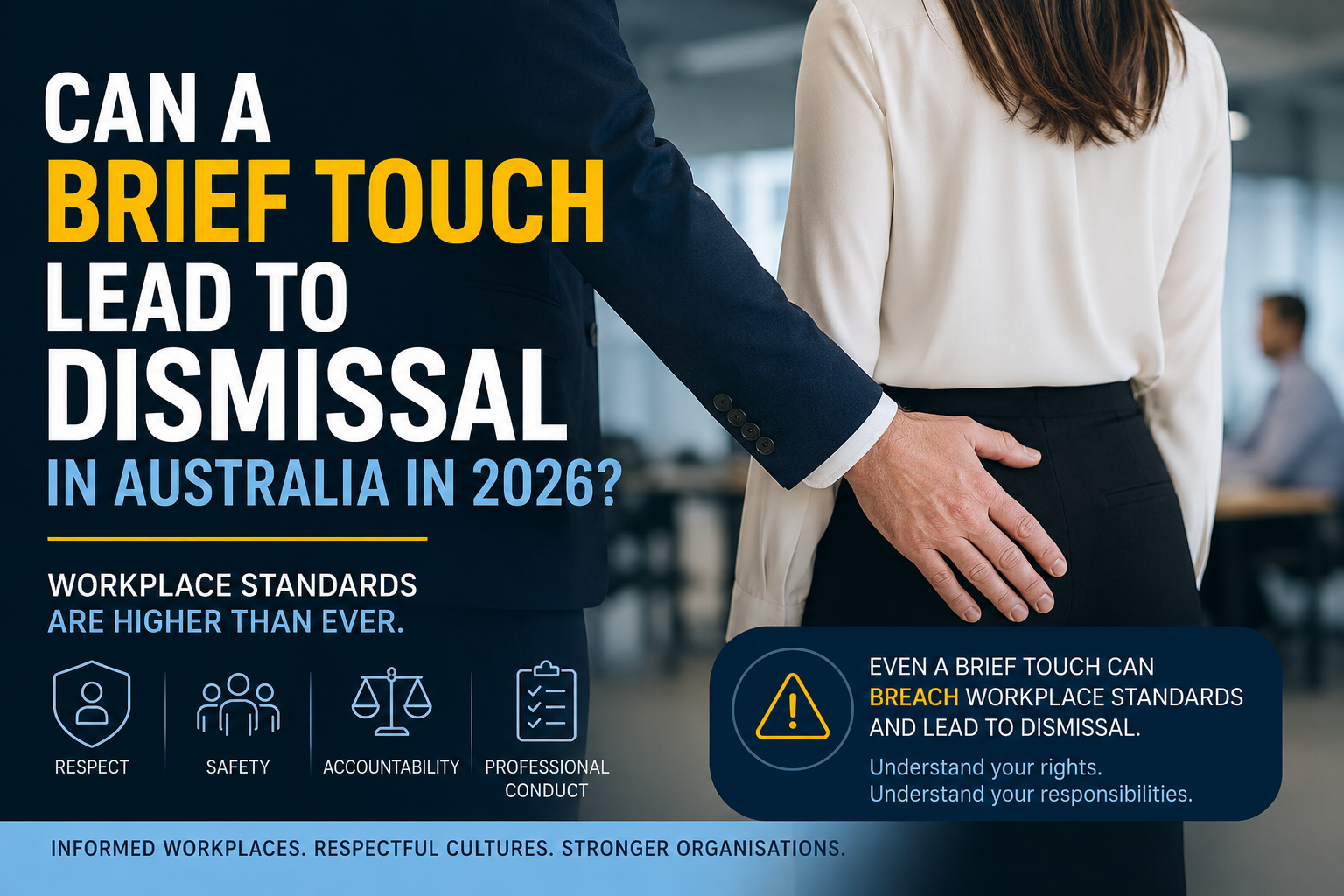
Many employees still believe that a brief physical interaction at work — a touch on the back, shoulder, waist or even buttocks — is unlikely to justify dismissal.

That assumption is increasingly risky.

Australian workplaces in 2026 operate under far stricter expectations concerning workplace behaviour, sexual harassment and psychological safety. Employers now face significant legal obligations to prevent inappropriate conduct, and tribunals are applying modern community standards when assessing workplace misconduct.

One Fair Work Commission decision that continues to influence employers and investigators is John Keron v Westpac Banking Corporation [2022] FWC 221. (DWF)

The decision sends a clear message:

Even a brief intentional touch can justify dismissal if it breaches workplace standards and undermines workplace safety and respect.

The attached draft article provided an excellent foundation for this discussion.

The Westpac Decision Still Matters in 2026

The case involved a senior Westpac manager with more than 35 years of otherwise unblemished service. After a compulsory professional development workshop, employees attended a work-related social gathering at a hotel venue.

Later in the evening, CCTV captured the employee placing his hand on a female colleague’s lower buttocks and moving it upwards toward her waist. Westpac conducted an internal investigation and terminated his employment for serious misconduct. The employee then challenged the dismissal in the Fair Work Commission.

Deputy President Binet upheld the dismissal. (DWF)

Importantly, the Commission acknowledged that community expectations regarding consent and workplace conduct had significantly changed.

The Commission stated:

“The bar as to what constitutes consent for physical and sexual interactions has been significantly raised in the broader community.” (DWF)

That observation remains highly relevant in 2026.

“It Was Only a Joke” No Longer Provides Protection

Historically, some workplace behaviour was minimised as “banter”, “harmless fun” or “nothing serious”.

Australian employers can no longer afford to adopt that approach.

The introduction of positive duties under anti-discrimination legislation, increased psychosocial safety obligations under work health and safety laws, and heightened public awareness following national workplace harassment inquiries have fundamentally shifted employer expectations.

Today, employers must actively prevent inappropriate conduct, not merely respond after the damage occurs.

That includes:

  • unwanted touching;
  • sexually suggestive conduct;
  • inappropriate jokes;
  • physical familiarity;
  • after-hours misconduct connected to work; and
  • behaviour occurring at conferences, Christmas parties or networking events.

The key issue is not whether the employee intended harm.

The key question is whether the conduct was unwelcome and whether it breached workplace standards.

Work Functions Are Still Workplaces

One of the most important aspects of the Keron decision involved the Commission’s finding that the conduct remained sufficiently connected to employment even though it occurred after formal work activities had ended. (DWF)

Many employees wrongly assume workplace rules stop applying once alcohol is served or official hours finish.

They do not.

In 2026, employers routinely investigate conduct occurring at:

  • Christmas functions;
  • conferences;
  • interstate travel;
  • training programs;
  • networking events;
  • client dinners;
  • sporting events; and
  • informal after-work drinks.

If there is a sufficient connection to employment, disciplinary action may follow.

The Fair Work Commission has repeatedly confirmed that out-of-hours conduct may justify dismissal where the behaviour damages workplace relationships, creates safety risks or harms the employer’s reputation. (Holding Redlich)

Alcohol Is Not an Excuse

Alcohol continues to play a major role in workplace misconduct investigations.

However, intoxication rarely excuses inappropriate conduct.

In Keron, the Commission accepted the employee had consumed substantial alcohol but still concluded the conduct justified dismissal. (Holding Redlich)

In fact, intoxication may increase employer concerns because impaired judgment can heighten workplace safety and reputational risks.

Employers now regularly remind staff that workplace behaviour expectations continue to apply regardless of alcohol consumption.

Training and Policies Matter

Another critical issue in the Westpac matter involved workplace training.

The Commission noted that Westpac had provided training concerning sexual harassment, discrimination and workplace conduct shortly before the incident occurred. (DWF)

That significantly strengthened Westpac’s position.

The lesson for employers is clear.

Policies sitting unread on an intranet will not adequately protect an organisation.

Training must be:

  • regular;
  • practical;
  • contemporary;
  • scenario-based; and
  • actively reinforced by management.

Employees should clearly understand:

  • what constitutes inappropriate conduct;
  • how workplace standards apply at social events;
  • the consequences of misconduct; and
  • how complaints will be investigated.

This issue is particularly important for councils, government agencies and SMEs where informal workplace cultures sometimes blur professional boundaries.

Procedural Fairness Still Matters

Importantly, stronger expectations around workplace conduct do not remove the obligation for procedural fairness.

Employers must still conduct proper investigations before making disciplinary decisions.

A fair investigation should assess:

  • witness evidence;
  • CCTV or electronic evidence;
  • surrounding circumstances;
  • workplace policies;
  • credibility issues; and
  • whether the alleged conduct actually occurred.

Australian tribunals continue to criticise employers who rush investigations or predetermine outcomes.

Even where allegations involve sensitive conduct, employers must ensure investigations remain impartial, balanced and evidence-based.

The 2026 Reality

The modern workplace has changed.

Conduct once dismissed as “minor” can now result in serious disciplinary action, including termination of employment.

Employees should understand that brief physical contact may still breach workplace policies, particularly where the conduct is intimate, unwelcome or capable of causing discomfort.

For employers, the message is equally clear:

Strong workplace culture requires more than policies alone. It requires leadership, training, consistent enforcement and professionally conducted investigations.

Failing to act appropriately may expose organisations to:

  • unfair dismissal claims;
  • sexual harassment complaints;
  • workers compensation claims;
  • psychosocial hazard investigations;
  • reputational damage; and
  • regulatory scrutiny.

In 2026, Australian workplaces are expected to be respectful, psychologically safe and professionally managed.

Tribunals are making it increasingly clear that employers who enforce those standards reasonably and fairly will often receive strong legal support from the Fair Work Commission. (DWF)
 

$90,000 Sexual Harassment Case: A Warning for Councils and Small Businesses

Sexual harassment penalty $90,000 Fair Work breaches – lessons for employers on liability, HR failures, and workplace compliance in Australia.

$90,000 Sexual Harassment Case: A Warning for Councils and Small Businesses


$90,000 Sexual Harassment Decision – What Council CEOs and SME Managers Must Learn From This Case

A recent Federal Circuit and Family Court decision has sent a very clear message to employers across Australia: failing to properly manage workplace sexual harassment and basic employment obligations can be extremely costly — both financially and reputationally.

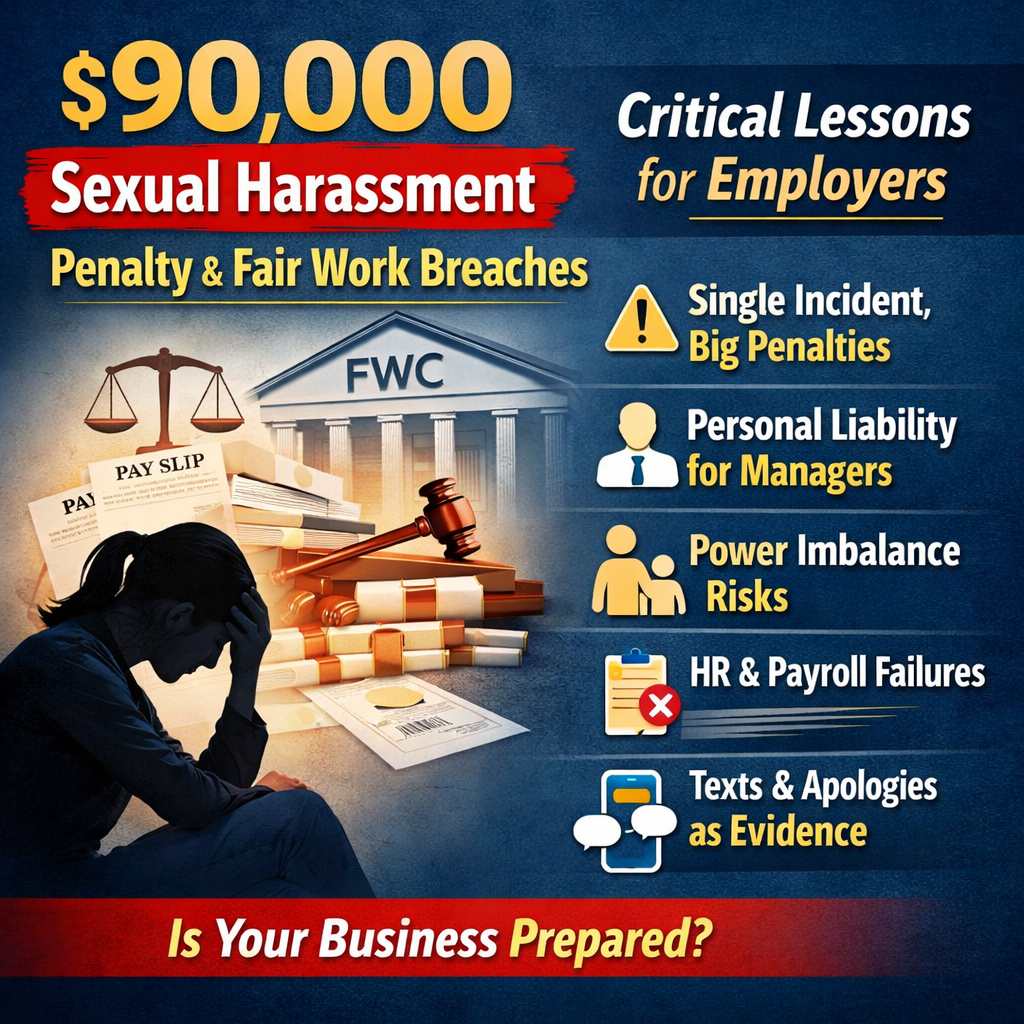
In Mejia v Capital City Café-Bar [2026], the Court ordered a café director to pay approximately $90,000 in compensation and penalties following a sexual harassment incident involving a young employee. This case is significant because it is one of the first published decisions under the new sexual harassment jurisdiction introduced under the Fair Work Act reforms in March 2023.

For Council CEOs, senior managers, and SME owners, this case provides several critical lessons.

What Happened in This Case?

The employee, a 23-year-old migrant worker, alleged that the café director hugged her, kissed her without consent, and attempted to offer her money while pinning her against a sink.

The incident occurred shortly after the employee had raised concerns about her pay and the fact that she had not been receiving pay slips. The employee did not return to work after the incident and later commenced legal proceedings.

The Court accepted that the incident caused distress, humiliation, and ongoing emotional impact, and compensation was awarded accordingly.

However, the sexual harassment itself was only part of the problem.

The Employer’s Bigger Problem – Multiple Fair Work Breaches

What significantly increased the penalties was the employer’s broader failure to comply with basic employment laws. The Court found the director had failed to:

  • Provide a Fair Work Information Statement
  • Provide a Casual Employment Information Statement
  • Provide pay slips
  • Pay correct wages including overtime and casual loading
  • Maintain proper employment records
  • Make the Award and National Employment Standards available
  • Provided false pay slips to the Fair Work Ombudsman

The Judge described this as a “comprehensive, if not complete, disregard for the obligations of a national system employer.”

This is a critical point for employers: sexual harassment cases often expose broader compliance failures.

Important Legal Development – New Sexual Harassment Jurisdiction

This case was brought under section 527D of the Fair Work Act, introduced under the Secure Jobs, Better Pay reforms.

This means employees now have another legal pathway to pursue sexual harassment claims — in addition to the Human Rights Commission and anti-discrimination processes.

In practical terms, this increases the legal risk for employers.

Key Takeaways for Council CEOs and SME Managers

  1. A Single Incident Can Result in Large Compensation

The Court made it clear that sexual harassment does not need to be repeated behaviour to result in significant damages.

Many managers still believe that a “one-off incident” is less serious.
This case confirms that is not how courts see it.

  1. Power Imbalance Matters

The Court placed significant weight on:

  • The employee being young
  • Being a migrant
  • Having limited financial resources
  • The offender being the business owner and in a position of authority

This highlights a major risk area for:

  • Small businesses
  • Councils
  • Family-run businesses
  • Workplaces where owners/directors deal directly with staff

Power imbalance increases damages.

  1. Poor HR Practices Will Make Everything Worse

The penalties were not just for harassment — they were for systemic non-compliance.

This is where many councils and SMEs are exposed:

  • No proper policies
  • No training
  • Poor documentation
  • Incorrect pay slips
  • No investigation procedures
  • No HR systems
  • No external investigator

When something goes wrong, these failures compound liability.

  1. Text Messages and Apologies Can Become Evidence

The director sent messages apologising and asking the employee to keep the incident secret.

This significantly damaged his case.

Managers and business owners often try to “fix things informally” after an incident.
This can make the legal situation worse.

  1. This Case Sends a Message About Personal Liability

Importantly, the director personally was ordered to pay penalties.

This is critical for:

  • Council senior managers
  • Directors
  • Business owners
  • CEOs
  • General Managers

You can be personally liable, not just the organisation.

What Organisations Should Do Now

This case clearly shows what organisations should have in place:

  1. A clear sexual harassment policy
  2. Complaint reporting procedures
  3. Investigation procedures
  4. Manager training
  5. Proper wage and payroll compliance
  6. Proper employment records
  7. Access to an external investigator
  8. Post-investigation follow-up processes

Organisations that do not have these systems are exposed to significant risk.

Final Thoughts

This decision is a warning to employers across Australia. The combination of sexual harassment and basic employment law breaches resulted in a $90,000 outcome for a single incident involving one employee in a small business.

For councils and SMEs, the message is very clear:

If you do not have proper workplace policies, complaint procedures, and investigation processes in place before something happens, it is already too late.

Prevention, proper procedures, and independent investigations are no longer optional — they are a critical part of risk management and governance.

If you have none of these, then contact ACCA ([email protected]). I can help protect you, your business, and your employees by ensuring you have the proper policies and ensuring matters are handled properly, fairly, and legally.

How to handle sexual harassment allegations in any workplace in 2026

Dealing with sexual harassment allegations

Sexual harassment is no longer something that sits only with Human Resources. In today’s workplace, it is a serious governance, risk, and leadership issue. Organisations in Australia are now expected to respond to sexual harassment allegations in a way that is fair, transparent, and professionally managed. When complaints are handled poorly, the consequences can include legal claims, reputational damage, low staff morale, and loss of trust in management.

This guide provides a practical, real-world approach to handling sexual harassment complaints in a way that is fair, legally defensible, and consistent with modern workplace expectations.

Understanding Sexual Harassment in Today’s Workplace

Sexual harassment is generally defined as unwelcome conduct of a sexual nature that causes a person to feel offended, humiliated, or intimidated. However, modern workplace investigations focus less on what the person intended and more on how the behaviour was experienced by the other person.

Sexual harassment can include:

  • Inappropriate jokes or comments
  • Unwanted physical contact
  • Repeated requests for dates
  • Suggestive emails, messages, or social media contact
  • Sharing inappropriate images or content
  • Behaviour that creates a hostile or uncomfortable work environment

Importantly, sexual harassment can occur in the office, at work functions, during travel, or through digital communication such as emails, messaging apps, and social media.

Why Handling Complaints Properly Matters

From a workplace investigation perspective, sexual harassment complaints are high-risk matters. If handled incorrectly, organisations may face:

  • Legal action
  • Workers compensation claims
  • Industrial disputes
  • Reputational damage
  • Loss of staff trust and morale
  • Media scrutiny, particularly in the public sector

For this reason, every sexual harassment complaint should be treated as a serious workplace complaint requiring a structured and procedurally fair investigation.

  1. Have a Clear and Practical Policy

Every organisation should have a clear sexual harassment and workplace behaviour policy. However, a policy is only useful if employees understand it and feel confident using it.

A good policy should:

  • Clearly define sexual harassment
  • Provide examples of unacceptable behaviour
  • Explain how to report a complaint
  • Outline the workplace investigation process
  • Commit to confidentiality and procedural fairness
  • Clearly state that retaliation will not be tolerated

Policies should be reviewed regularly to ensure they reflect current Australian legislation and workplace expectations.

  1. Make Reporting Safe and Accessible

One of the biggest issues in sexual harassment matters is underreporting. Many employees do not report behaviour because they fear retaliation, believe nothing will happen, or worry it will damage their career.

Organisations should provide multiple ways for employees to report concerns, such as:

  • Reporting to a manager
  • Reporting to HR
  • Anonymous reporting channels
  • Reporting to an external investigator
  • Whistle blower channels (where appropriate)

Providing access to an independent workplace investigator is often considered best practice, particularly in small businesses, local government, and organisations where conflicts of interest may arise.

  1. Take Every Complaint Seriously

A common mistake, organisations make is trying to “informally resolve” serious allegations too quickly or dismissing behaviour as a misunderstanding or personality conflict. This can significantly increase organisational risk.

Every complaint should be assessed properly and, where appropriate, referred for a formal workplace investigation. Even if the allegation appears minor, it should still be documented and assessed.

  1. Act Quickly — But Fairly

Timeliness is critical in sexual harassment investigations. Delays can:

  • Increase stress for the complainant
  • Lead to evidence being lost
  • Create perceptions that the organisation is ignoring the issue
  • Increase legal risk

However, acting quickly does not mean rushing to judgement. A fair investigation requires:

  • No assumptions
  • Proper evidence gathering
  • Interviews with relevant witnesses
  • Procedural fairness for all parties

The best approach is to acknowledge the complaint immediately and commence a structured investigation as soon as possible.

  1. Ensure Independence in the Investigation

One of the most important decisions an organisation can make is who conducts the investigation.

In many cases, particularly in SMEs, family businesses, and local government, using an external workplace investigator is the safest and most defensible option. An external investigator:

  • Removes perceived bias
  • Provides independence
  • Brings investigation expertise
  • Improves credibility of the outcome
  • Reduces organisational risk
  • Ensures procedural fairness

This is particularly important where allegations involve senior staff or management.

  1. Follow a Structured Workplace Investigation Process

A proper sexual harassment investigation should include:

  • A clear investigation plan
  • Formal interviews with the complainant, respondent, and witnesses
  • Collection of evidence (emails, messages, CCTV, personnel files, etc.)
  • Maintaining confidentiality
  • Making findings based on evidence
  • Preparing a formal investigation report

Good documentation is essential. If a decision is later challenged in court or a tribunal, the investigation report and evidence will be critical.

  1. Prevent Retaliation

Retaliation after a complaint is made is one of the biggest risks to an organisation. Retaliation can include:

  • Excluding someone from meetings
  • Changing shifts or duties unfairly
  • Performance managing someone unfairly
  • Bullying or victimisation
  • Termination or demotion after a complaint

Employers have a legal obligation to prevent victimisation. This means actively monitoring the workplace after a complaint is made and after the investigation is completed.

  1. Make Findings and Decisions That Are Defensible

At the conclusion of the workplace investigation, findings must be based on evidence — not opinions, assumptions, or office politics.

Possible outcomes may include:

  • No finding
  • Training or counselling
  • Formal warning
  • Final warning
  • Demotion
  • Termination of employment

The key is that the outcome must be proportionate, consistent, and clearly linked to the investigation findings.

  1. Communicate the Outcome Carefully

Both the complainant and the respondent should be advised of the outcome in a professional and respectful way. While confidentiality must be maintained, both parties should understand that the complaint was taken seriously and investigated properly.

Poor communication at this stage can undo an otherwise well-run investigation.

  1. Provide Ongoing Support

A workplace investigation does not end when the report is finished. Employers should:

  • Check in with the complainant
  • Monitor the workplace environment
  • Ensure no retaliation occurs
  • Provide access to EAP or counselling if required
  • Consider whether team training or cultural change is needed
  1. Focus on Prevention, Not Just Response

The best organisations understand that preventing sexual harassment is far better than investigating it after it occurs.

Prevention strategies include:

  • Regular workplace behaviour training
  • Clear behavioural expectations
  • Strong leadership
  • Early intervention when issues arise
  • Culture and staff surveys
  • Independent reporting options

Prevention is an ongoing process, not a once-a-year training session.

  1. Leadership Sets the Workplace Culture

Workplace culture is driven from the top. If leaders ignore behaviour, minimise complaints, or avoid difficult issues, employees will notice.

Leaders must:

  • Model respectful behaviour
  • Act on complaints
  • Support fair investigations
  • Be visible in their commitment to a safe workplace

Without leadership support, policies and training will have very little impact.

  1. Always Look for Improvement

Every workplace investigation provides lessons. Good organisations review each matter and ask:

  • Did our reporting process work?
  • Was the investigation handled quickly?
  • Was the process fair?
  • Do we need better training?
  • Are there cultural issues we need to address?

Continuous improvement reduces future risk.

Conclusion

Handling sexual harassment allegations in 2026 requires more than simply following a policy. It requires professionalism, procedural fairness, independence, and strong leadership. Organisations that respond properly not only reduce legal and reputational risk, but also build safer, more respectful workplaces where employees feel confident to speak up.

If your organisation requires an independent workplace investigator or advice on handling a sexual harassment complaint or workplace investigation, ACCA Aust provides professional, independent investigation services across Australia.

Understanding and recognising sexual harassment in the workplace

Sexual harassment is an alarming, pervasive issue that continues to plague workplaces across the globe. It is gender discrimination involving unwanted sexual advances, requests for sexual favours, or other verbal or physical sexual conduct. The impact of sexual harassment is multi-faceted. It affects individuals, the organisation, productivity, the culture of the organisation, and the overall work environment. 

Types of sexual harassment

Sexual harassment typically falls into two categories: ‘Quid pro quo’ and ‘Hostile Work Environment’.

Quid pro quo’ sexual harassment occurs when job benefits–such as promotions, raises, or continued employment–are tied to the submission to sexual advances or requests. For example, if a supervisor suggests an employee might receive a promotion if they go on a date. This would be quid pro quo harassment. 

Hostile Work Environment’ harassment occurs when an employee is subjected to sexual jokes, comments, imagery, or any other sexual behaviours to a degree that the work environment becomes intimidating, hostile, or offensive, or when their performance is adversely affected. For example, if a group of employees frequently share explicit content or make sexual remarks about another employee, leading them to feel uncomfortable or unsafe. This is considered a hostile work environment. 

Indicators of sexual harassment

Recognising sexual harassment in the workplace often means being aware of various indicators, which can include unwanted sexual advances, sexual jokes, or comments, sexual or offensive material, inappropriate communications, sexual favouritism, retaliation, hostile work environment, sexual assault, and stalking or obsessive behaviour. 

Unwanted sexual advances can range from suggestive comments to unwelcome touching or physical closeness. For example, an employee might constantly face intrusive inquiries about their personal life, receive unwelcome compliments about their physical appearance, or even find a co-worker invading their personal space.

Sexual jokes or comments can involve lewd jokes, suggestive remarks, or sexually explicit language. Suppose someone frequently subjected an employee to colleagues making sexually offensive jokes or comments about their appearance or sexual orientation, despite expressing their discomfort. In that case, they are experiencing sexual harassment.

Sexual or offensive material refers to the display of sexual or offensive material, such as explicit images or videos. For example, if explicit content is frequently shared in a group chat, or sexually explicit images are displayed in the workspace, this could constitute sexual harassment. 

Inappropriate Communications can be emails, text messages, or social media interactions with sexual undertones or inappropriate comments. For instance, receiving unsolicited sexually explicit emails or messages from a co-worker or supervisor is a form of sexual harassment.

Sexual Favouritism is when decisions about promotions, job assignments, or other work benefits are based on submission to sexual advances or favours. If an employee notices that colleagues who engage in sexual relationships with superiors receive preferential treatment, it can be sexual favouritism, “quid pro quo” harassment.

Retaliation can occur if someone complains about sexual harassment and then experiences negative consequences at work, such as being demoted, fired, given fewer desirable assignments, or otherwise treated poorly. Retaliation is a form of sexual harassment and is illegal in numerous jurisdictions.

The Hostile Work Environment is when the workplace is permeated by sexual conduct, comments, or innuendos that make an employee feel uncomfortable, intimidated, or distressed.

Sexual Assault includes any unwanted sexual contact or activity. Any form of non-consensual physical contact, from touching to more severe actions, falls into this category and is not only harassment but also a criminal offence.

Stalking or Obsessive Behaviour involves unwelcome attention, such as persistent calls, messages, or following someone around. A pattern of obsessive focus, repeated attempts at contact, or disturbing messages may signal this type of harassment. 

The impact of sexual harassment on victims and the workplace.

Sexual harassment takes a significant toll on its victims, leading to psychological, emotional, and sometimes physical distress. Victims may experience depression, anxiety, sleep disturbances, and a host of other mental health issues. The emotional toll can also affect their personal relationships and overall quality of life. 

The impact of sexual harassment extends beyond the individual, affecting the workplace. It can lead to decreased productivity, increased absenteeism, higher turnover rates, and a decline in job satisfaction among employees. When employees do not feel safe or respected, their engagement and output inevitably suffer.

Sexual harassment also affects the overall culture of an organisation. It can breed an environment of fear and mistrust, damaging team cohesion and collaboration. In the long term, a company’s reputation can be severely damaged, affecting its ability to attract and keep top talent. 

What employers can do to prevent sexual harassment?

Preventing sexual harassment in the workplace requires a multi-faceted approach from employers. A clear, comprehensive sexual harassment policy should be in place, outlining what makes up harassment, the consequences of such behaviour, and the procedure for reporting it.

Training and awareness programs are also crucial. Employers/Management should educate employers about the different forms of sexual harassment, how to recognise them, and how to respond. Bystander intervention training can also be effective, empowering employees to intervene when they witness inappropriate behaviour.

Legal consequences of sexual harassment 

The legal consequences of sexual harassment can be severe for both individuals and companies. Individuals may face disciplinary actions, termination, and legal penalties, including lawsuits and fines. Victims can hold companies liable for the harassment committed by their employees, particularly if they were aware of the harassment and did not appropriately address it. They may face lawsuits, hefty financial penalties, and severe damage to their reputation.

Conclusion

Recognising and addressing sexual harassment in the workplace is not just a legal obligation—it is a moral one. It is crucial to cultivating a safe, respectful, and productive work environment for all employees. By understanding what makes up sexual harassment, its impact, and how to prevent it, we can all contribute to a fairer and more respectful workplace.

Contact ACCA for an independent review/investigation if you have concerns about sexual harassment in your workplace (www.acca-aust.com.au

#LeadershipResponsibility #WorkplaceSafety #SexualHarassmentAwareness #HumanResources

The Danger Season is Approaching

The Christmas season is fast approaching. Parties are being planned. 

Joy and happiness abound as we move to a festive season without Covid restrictions.

However, danger lurks- what may occur at the Christmas party? 

Christmas parties can be a WHS minefield! 

Exuberant guests fuelled by alcohol may cross the line with comments and actions. 

Alcohol may also lead to accidents at the venue and travelling from the venue.

Employers have a responsibility to act to ensure the safety and welfare of staff and associates at the parties.

Some actions may include:

• Make sure the venue has no “hidden” dangers which may expose employees to accidents. Potential hazards which may cause a fall, a slip or trip.
• Limiting and monitoring alcohol consumption.
• Providing access to transport (Uber, Taxis etc) to make sure people travel safely after the event.
• Reinforce with employees the expected behaviour and limitations on consumption of alcohol at the event.
• Appoint people to monitor conduct at the function.

Remember the function is still a workplace even though it is a Christmas party. The Code of Conduct and behaviour guidelines apply.

Overindulgence in alcohol has the potential to increase the risk of accidents and sexual harassment. Remember the bar on sexual harassment is lower now–inappropriate touching and/or comments will open the door to a claim.

What do I do if someone complains? The most important thing is to treat the complaint seriously. Do not write it off. Respond in a timely manner. Arrange for a fair and confidential workplace investigation. The investigation must provide procedural fairness to everyone.

ACCA can assist with an independent, unbiased investigation. This removes any allegations of actual or perceived conflict of interest. See www.acca-aust.com.au or contact me direct at [email protected].

When Sex Takes Over

Sexual Harassment ACCA Blog Post

When sex takes over

Sex and alcohol in the workplace can lead to major trouble.

Today I would like to review a matter involving sex, alcohol and lies.

First, let me set the scene:

It is a combined Christmas party and a farewell party. The company paid $25 a head towards the costs of the function. Several employees attended it.

Before the function, several employees went to a hotel (“A”) for pre-dinner drinks.

Other employees arranged accommodation at another hotel–we will call this hotel “B” for clarity.

The function was well lubricated with copious amounts of alcohol flowing.

To describe the function and subsequent activities as bawdy would not do it justice.

After the function, several employees returned to Hotel B. One of these (we will call Madam X for her sake) came to the room with other employees. Some employees were trying to sleep despite the interruptions.

Madam X decided it would be great to have a little fun–she had a bath with two other employees. She then stood at the bathroom door with a bath towel around her body while another employee went to the toilet.

That must have triggered something in her, so she jumped in the bath with two employees. She then had sexual intercourse with another employee then another.

All of her actions were within the view and/or earshot of other employees in the room.

The complaint

The behaviour of Madam X and the other employees who engaged in the sexual behaviour and exhibition shocked one of the other employees. She rang the Acting Manager of the store–she was hysterical as she outlined the conduct. The manager confirmed the conduct by speaking with two other employees who were present.

One person could not come to work because she was crying and hyperventilating. Another employee stated she was distressed and disgusted by the activities.

The company suspended the employees involved in the sexual activities.

The investigation

The company spoke to employees who were present. These employees confirmed the activities and expressed disgust by what had occurred. Some expressed remorse about not stopping the conduct before it escalated.

The investigator questioned Madam X. She initially denied having sex. She said she could not remember. She inferred she was so affected by alcohol she could not remember what happened.

The investigator questioned her again some two weeks later. He asked specific questions about the sexual activity on the night. She replied “no comment” or she did not recall.

The interviewer then told her:

• “[W]e feel you have been dishonest with us throughout this interview process. In particular, you have lied to us about:
• Whether you had sex with [the fourth employee].
• Whether you had sex with [another employee].
• Your recollections of what happened that night at the hotel; and
• What you did in the bathroom with [another employee] and [the fourth employee].
• Do you have anything to say about this?”

Madam X replied with “No comment.”

You should note when Madam X gave evidence at the Australian Industrial Relations Commission (Commission) she admitted she engaged in the alleged sexual activities. She was too embarrassed to tell the truth.

The company advised her, during the second interview, they were considering ending her employment because of her activities and dishonesty when questioned about her activities. The investigator asked her if she wanted to respond to this or to provide any further information. She did not.

The company ended her employment.

Initial hearing in the Australian Industrial Relations Commission

Madam X referred to the Commission as she argued against termination. The Commission addressed two issues–sexual harassment and her dishonesty.

The Commissioner commented on sexual harassment occurring when unwelcome sexual conduct occurred in the presence of a person. Was the person sexually harassed? The conduct occurring in circumstances in which a reasonable person engaging in the conduct, having regard to the circumstances, would have expected the person harassed would be offended, humiliated or intimidated.
He then determined he would not characterise her conduct as sexual harassment or, even if considered sexual harassment, the conduct was only of the “indirect kind.”

The Commissioner then reflected on her failure to answer questions truthfully during the investigation. He considered a previous decision where dishonesty resulted in dismissal. He then referred to the conduct of Madam X:

The conduct about which Madam X lied was of an inherently personal nature. Lying is never to be condoned. However, given the nature of the conduct about which she has been untruthful, I do not consider that any dishonesty on her part has been such that it should be regarded as likely to destroy the necessary relationship of trust between an employer and employee. In drawing this conclusion, I have also had regard to the evidence of [the Assistant Manager of the xxx store] who said that he had no reason to believe that Madam X was dishonest when it came to stock or cash.

He then made these comments about the matter:

• Allegations of sexual harassment must be taken seriously by employers. Indeed, they may be held liable for sexual harassment by their employees even where this occurs out of hours and away from the workplace.
• I have rejected the argument that there was no connection between Madam X’s conduct and her employment.
• The respondent’s submissions greatly exaggerated the seriousness of Madam X’s misconduct, particularly the suggestion that she committed a criminal act of obscenity. Moreover, I have found most of the behaviour complained of either did not constitute sexual harassment as defined by the SDA or only did so in a relatively marginal way.
• As the respondent conceded, the less direct the relationship with the workplace the more serious the misconduct would need to be to justify termination of employment. Most of the impugned behaviour occurred well away from the workplace, after rather then [sic] during a work function, in a hotel room that was booked and paid for privately.
• In all the circumstances, Madam X’s conduct was not so serious as to constitute a valid reason for the termination of her employment.
The Appeal
The matter went to appeal. The grounds were the Commissioner:
• Misconstrued and/or misapplied s.652(3)(a) by failing to consider and determine the effect of the conduct on the welfare of other employees.
• Failed to make necessary findings of fact and law, in deciding whether there was a valid reason for the termination.
• Erred in the construction and application of s.28A(1)(b) of the Sex Discrimination Act 1984 (Cth).
• Erred by making an order of re-instatement without making findings of fact regarding whether an appropriate level of trust and confidence could be re-established, given the respondent’s dishonesty.
• Misconstrued and/or misapplied the test of what constitutes a valid reason for termination by failing to consider relevant matters and requiring the appellant to establish serious misconduct.

The matter wound its way through the various avenues in the Australian Industrial Relations Commission. It was eventually determined the termination of Madam X’s employment was not harsh, unjust, or unreasonable. They quashed the previous judgements.

It is interesting to note this is a 2007 matter–I believe the initial determination (the one appealed) would be different if they addressed the conduct today.

See Australian Industrial Relations Commission Appeal by Telstra Corporation Limited C2007/3458)

Take aways

• Employers should make comprehensive notes relating to the investigation process.
• Explore all evidence both for and against the respondent
• Lock in witnesses with a formal statement
• Provide procedural fairness in all aspects of the investigation.
• Take positive action if the circumstances warrant it.

Contact ACCA if you want any assistance with policies and/or investigations concerning sexual harassment in the work place.

Mick Symons – ACCA (www.acca-aust.com.au)

Bullying in the Workplace

Bullying in the Workplace Anti Corruption Consultants Blog

Bullying in the Workplace – An In Depth Overview

Not so long ago bullying in the workplace was seen as a sport in some Australian work places. Employees were subjected to “pranks” disguised as initiation rites. These varied from physical abuse to mental abuse to ridiculing employees.

These pranks should no longer be tolerated! However, there is still a belief, in some areas, they are “only harmless fun”. The psychological harm will affect employees and your firm will suffer reputational damage when matters are reported in the media and you face a court.

The employer has an obligation to prevent bullying in the workplace. You must take reasonable care to ensure behaviour in the workplace does not adversely affect the health and safety of other persons.

The Australian Human Rights Commission claimed (2015) workplace bullying cost the Australian economy up to $36 billion each year. The average cost of each case amounting to $17,000-$24,000 for employers.

There are also substantial legal penalties under Occupational Health and Safety legislation across various jurisdictions.

Bullying has an indirect of profitability – it affects:

  • Higher absenteeism and turnover of staff
  • Lower morale
  • Decreased productivity
  • Legal and workers’ compensation claims
  • Costs of internal or external investigations
  • Loss of productivity my managers who have to address issues flowing from the behaviour.

What is Workplace Bullying?

Workplace Bullying ACCA

Workplace bullying is repeated and unreasonable behaviour towards a worker or group of workers. The conduct creates a risk to health and safety.

The behaviour must be repeated. This infers a “one-off” incident should be disregarded as it is not, according to the definition, “bullying”.

The conduct may be against a worker or a group of workers, The conduct must create a risk to health and safety.

While a single incident of unreasonable behaviour is not considered workplace bullying, it is important to take appropriate action if there are any instances of inappropriate or disrespectful behaviour. This action is required to prevent any escalation. A record must be kept of any intervention in such circumstances.

Role of the employer

The employer MUST provide a workplace that is safe and without risks to health. This requires the employer to provide and maintain appropriate work systems. This is reinforced by legislation across Australia.

The employer should know the potential for workplace bullying and implement the appropriate policies and training procedures to control the risk.

You should involve employees when developing policies. Legislation may require involvement of employees in workplace health and safety committees.

It is recognised prevention is the best way to prevent bullying in the workplace.

Preventive Measures

Developing a strong workplace culture

This is a significant factor in preventing bullying. A strong positive culture sets the standards and conduct in the workplace. While everyone in the workplace contributes to culture, management has a greater influence and responsibility to establish a positive culture in the workplace.

Setting standards and establishing agreed values.

Employers are obligated under Occupational Health and Safety (OHS) legislation to provide a safe workplace. They must, as far as reasonably practicable, ensure there are no risks to physical health and safety or psychological trauma.

Employers should clearly outline expected values and standards of behaviour to provide a safe environment. This can be in an agreed standard (code of conduct) or specific policies targeting bullying. Employees should, where appropriate, assist to develop these policies.

The acceptance of such policies will assist in reducing incidents of bullying.

Effective leadership

There must be a commitment at all managerial and supervisory levels to prevent and respond to workplace bullying.

Effective leadership will, by example and action, reduce the potential for workplace bullying. Leaders must train employees and lead by example.

Strong leadership is required when any incidents occur.

Workplace policies and procedures addressing bullying

Workplace Bullying - Harassment - Policies

Employers should consult with employees to develop and implement a workplace policy and procedure to address workplace bullying. This will ensure a consistent approach within the company to prevent and respond to any incidents of workplace bullying.

This policy would set the standards of expected behaviour in the workplace. It would also reinforce that bullying behaviour would not be tolerated.

Workplace bullying policy

The policy should take a guiding approach by outlining how everyone should behave and be treated at work. It should also incorporate a preventive approach clearly outlining what behaviour would not be tolerated.

The policy could be a standalone document or incorporated into the code of conduct.

The policy should be developed in conjunction with the employees using an Occupational Health & Safety committee approach where appropriate.

What should be in the policy

The policy should include:

  • A statement from management outlining a commitment to providing employees with a healthy and safe working environment.
  • Identification of the expected standard of behaviour from all employees.
  • Examples regarded as workplace bullying, and examples of appropriate managerial oversight.
  • If appropriate, address the various methods of communication that may be used including personal text messages, emails, and social media.
  • A section on how an employee can report incidents of workplace bullying with a reference to support programs to help the reporting parties.
  • A commitment from management to treat reports of workplace bullying seriously.
  • Information on how management would respond reports indicating impartiality and confidentiality where appropriate.
  • How reports would be investigated.
  • Highlight what action may be taken if the reports are substantiated.
  • Where employees can get more information about workplace bullying.

Promoting the Policy

The policy should be promoted and communicated all employees. This should include posters on notice boards, a regular topic on team meetings, advice on intranet pages, and regular discussion with employees.

All employees should receive a copy of the policy on induction. It should also be incorporated as a topic or specific training program at least every 12 months.

The policy should be regularly reviewed.

Encourage reporting

Employees will report instances of bullying if they are confident the organisation will address these reports in line with the bullying policy.

The policy and any promotional material clearly outlines the reporting structure. Employees should be assured the reports will be considered and treated as confidential where appropriate.

Employees should be encouraged to report any incidents as this would allow the employee to take urgent action to address any issues so they do not escalate. The employer can also determine whether their prevention methods are effective.

Reporting will also allow employers to provide prompt assistance and support to employees to mitigate any ongoing stress-related issues.

Transparency

The employer should be transparent when addressing instances of workplace bullying. This may include advice to employees as to what action they took in relation to allegations workplace bullying. It is important to acknowledge the need for confidentiality when promoting this action.

General information can be provided as part of any regular communication process across the organisation. This information may include:

  • The number of reports received
  • The number of reports resolved
  • Time taken to complete investigations
  • Whether the investigation was conducted internally or externally
  • The general nature of the outcome of the investigations (be conscious of the need to maintain confidentiality where appropriate).

Training within the workplace

Workplace Bullying and Harassment Training

Occupational Health & Safety legislation highlights the responsibilities of an employer to provide information, instruction, training, and supervision to all employees to ensure they work in a way that is safe without risks to health.

This includes information relating to workplace bullying. It is important supervisors are fully aware of what comprises as workplace bullying and their obligations to address any identified issues within the workplace. You may be required as the employer to provide specific training in this area to all supervisors and managers.

Induction

Induction must include information about workplace bullying, including relevant policies and procedures.

Induction training should be provided to permanent employees, casuals, contractors, and volunteers. Labour hire personnel and visitors should know polices relating to bullying in the work place.

Training

It is important training is provided to all employees. This training should be comprehensive with an emphasis on what comprises workplace bullying and what action should be taken if the employee witnesses the conduct or is a victim of workplace bullying.

The training should also emphasise the expected standards of behaviour in the workplace.

Supervisors/Managers should receive targeted training highlighting their responsibility to ensure a safe workplace. This training should include:

  • Role of communication – how to communicate with various parties
  • Managing the “difficult conversation” about workplace bullying
  • Providing formal and informal constructive feedback to all parties
  • Monitor and address potential issues leading to workplace bullying
  • Conflict resolution to address potential issues
  • What action to take if a report is made

Impact of Workplace Bullying

Workplace bullying can affect people in many ways. It can lead to:

  • Distress, anxiety, panic attacks or sleep disturbance
  • Physical illness, such as muscular tension, headaches, and digestive problems
  • Reduced work performance
  • Loss of self-esteem and feelings of isolation
  • Deteriorating relationships with colleagues, family, and friends
  • Depression
  • Increased risk of suicide

Examples of workplace bullying

Workplace Harassment ACCA

Workplace bullying can include:

  • Abusive, insulting, or offensive language or comments (including belittling, demeaning, or patronising someone, especially in front of others)
  • Yelling or screaming at an employee
  • Unjustified or unreasonable criticism or complaints
  • Singling someone out and treating them differently from others
  • Withholding information, supervision, consultation, training, or resources deliberately to prevent someone doing their job
  • Setting unreasonable timelines or constantly changing deadlines
  • Spreading misinformation or malicious rumours
  • Changing work arrangements, such as rosters and leave, to deliberately inconvenience someone
  • Setting tasks unreasonably below or above someone’s skill level
  • Humiliating, shouting at or threatening someone
  • Excluding someone from participating in activities relating to their work
  • Refusal to acknowledge contributions and achievements (such as discovering that a person’s work – and the credit for it – has been stolen or plagiarised)
  • Initiation or hazing – where someone is made to do humiliating or inappropriate things
  • Teasing or playing practical jokes
  • Refusing annual leave, sick leave, and especially compassionate leave without reasonable grounds
  • Playing mind games, ganging up or other psychological harassment
  • Intimidation (making someone feel less important and undervalued)
  • Undermining work performance by deliberately withholding information vital for effective work performance
  • Constant unconstructive criticism and/or nit-picking
  • Suppression of ideas
  • Overloading a person with work or allowing insufficient time for completion and criticising the employees work in relation to this
  • Utilisation of various social media platforms and emails

It is important to realise any physical contact such as pushing, shoving, tripping, or grabbing is an assault. These actions should be taken seriously and, where appropriate, reported to the police so there is a record of the conduct.

The same applies to any threatening behaviour or physical contact with a weapon of any description including tools or other weapons (knives, guns, clubs). This must be reported to the police.

What is not considered workplace bullying

While some work practices may appear unfair they are not regarded as bullying if the conduct falls within accepted work practices and are done reasonably.  

The following are examples of what is not considered as bullying if conducted reasonably.

  • Setting realistic and achievable performance goals, standards, and deadlines
  • Fair and appropriate rostering and allocating working hours 
  • Transferring someone to another area of the organisation/business or role for operational reasons
  • Deciding not to select a worker for promotion where a reasonable process is followed
  • Informing a person about their unsatisfactory work performance in an honest, fair, and constructive way
  • Informing someone of their unreasonable behaviour in an objective and confidential way
  • Implementing organisational changes or restructuring
  • Taking disciplinary action, including suspension, or terminating employment where appropriate or justified in the circumstances.

What can increase the risk of bullying in the workplace?

These factors can increase the potential for bullying in the workplace.

Work stressors

High job demands, limited job control, organisational change, role conflict, job insecurity, tolerating unreasonable behaviour or a lack of behavioural standards, unreasonable expectations of clients or customers.

These can lead to frustrations within the general workforce and management.

Leadership styles

An authoritarian leadership style does not allow for employee interaction. It is a “damn it – do it” approach with no guidance or advice.

The is a lack of formal delegation leading to more assertive employees taking an inappropriate oversight role.

Work systems

Inappropriate workplace practices, lack of resources or training can create stress in the workplace. Unreasonable key performance standards, unrealistic expectations or time frames will also lead to stress in the workplace.

The stress leads to issues on the floor resulting in bullying as a potential outlet to reduce it.

Work relationships

Relationship between employees is also a key factor. Poor communication between management and employees, and employees themselves is also another factor. Low levels of managerial support opens the door for bullying. Ongoing conflict will also lead to bullying.

Workforce personnel

Research highlights some employees are more at risk from workplace bullying. These include, but not necessarily limited, to apprentices, casual employees, younger employees, injured employees, or those returning to work after an injury.

Employees who lodged a complaint are also likely to be targeted on return to work.

Bullying is also associated with ethnicity, religion, gender, disability, or sexual preferences.

What should I do if I am bullied at work?

You need a record of what occurred. This is important if the matter is going to be followed up.

The record should include such details as:

  • Date and time of incident
  • What happened before the incident?
  • Details of the incident
    • What happened
    • Who was involved
    • What was said
    • Who said anything
  • Any witnesses
  • What occurred after the incident?
  • Where did the incident occur?
  • Was there any CCTV coverage?
  • Was there any damage to clothing?
    • If so, keep the clothing after the incident if possible. If not, photograph damage.
  • Were you injured in anyway (cuts, bruises)
    • Photographs where possible
    • If you had medical treatment then keep details of where and when treatment occurred. Who provided the treatment.
  • Note your feelings flowing from the incident
    • Were you upset?
      • If so – why?
    • Were you embarrassed?
      • If so – why?
  • Why do you believe the conduct was bullying.
  • You need to tell someone what happened. There may be a contact listed under occupational health and safety procedures.
  • If you are a member of the Union then consider speaking with your delegate.

Remember, bullying is repeated behaviour. Your records will support the repetition of the conduct.

The employer must provide you with a safe work environment free of bullying and harassment. If the firm takes no action then it would be appropriate to refer your complaint to the Union if you are a member.

Remember, if you believe you are in immediate danger then, if possible, leave the workplace. You should (if appropriate) ring 000 for police assistance.

If you believe the incident was serious and you feared for your safety then report the incident to the police. Conduct leading to you fearing for your safety may be assault. Police will take the appropriate action.

Summary

The onus is on management to ensure there is an effective policy and procedure to address workplace bullying. However, eliminating workplace bullying requires action from everyone in the workplace.

Employees must be courageous in addressing this issue. Bullies will sidestep preventive measures. They will also use more subtle ways to target people. Gradual ostracization or exclusion can erode the confidence of a person. The “pain” of this is not visible like a bruise or cut but it can eat away at the victim.

Bullies use social media and other subtle methods to target victims. A bully is normally an informal leader, others see his actions as non-harmful, just a “joke”. Get over it, it is all in fun and other comments lead to a further erosion of self confidence in the victim.

A failure to report incidents leads to an escalation as the bully gains further confidence in not being sanctioned for his/her actions. A failure by other workers to report the incidents means they are complicit in the bullying as if they were taking the action against the employee.

The company must act – a failure to do so will expose the company to litigation leading to penalties under legislation and in the civil jurisdiction.

Sexual Harassment Equals a Touch

ACCA Sexual Harassment in the Workplace

Is a “brief” intentional touch on the backside of an employee enough for dismissal?

Westpac employees attended a “sundowner” event after a professional development day. Attendance was voluntary – employees were not paid. During the evening, a long-standing senior manager briefly touched an female colleague’s backside. CCTV captured the incident. 

The company held an internal investigation and terminated the manager even though he had an unblemished record. The manager brought forward an unfair dismissal claim. 

The matter was heard in the FWC before Deputy President Binet on 4 February 2022 (John Keron v Westpac Banking Corporation U2021/3637). Ms Binet found in favour of Westpac. She highlighted the change in community standards around sexual harassment and conduct in the workplace have changed in recent years. All employees should know these changes. 

She highlighted the new standard within the workplace was higher than previously accepted. There was a view community standards guide the law and how courts respond to cases. Courts reflect these standards in reaching determinations. 

Westpac conducted employee training with a focus on “Doing the Right Thing”. The focus was sexual harassment, discrimination and bullying. Mr Keron participated in this training two months before the incident. The training was considered during the decision. 

Key takeaways: Have a clear policy relating to conduct must be enforced through regular (at least every year). Failure to do so may lead to the Commission assuming the company did not think sexual harassment an important issue (see more here)  

#unfair_dissmissal #sexual_harassment

FREE Fraud Health Check for Small Businesses

Think you might be the Victim of Fraud? 

Fill out the form below to get sent our free survey that provides you with an indication of the potential vulnerability of your business to fraudulent activities.

    FREE Fraud Health Check for Businesses

    Think you might be the Victim of Fraud? 

    Fill out the form below to get sent our free survey that provides you with an indication of the potential vulnerability of your business to fraudulent activities.