
Interview Techniques for Workplace Investigations
Explore key investigative interviewing methods, from PEACE to Strategic Use of Evidence, and learn how to conduct fair, defensible workplace investigations
Investigative interviewing sits at the heart of most workplace, regulatory, and integrity investigations. Yet it remains one of the most misunderstood parts of investigative practice. Too often, interviews are treated as informal conversations or, at the other extreme, as confrontational exercises designed to secure admissions.
In reality, effective investigative interviewing is neither casual nor coercive. It is a disciplined, evidence-led process requiring judgement, preparation, and a clear understanding of the strengths and limitations of different interviewing methods.
This article outlines the key investigative interviewing models commonly used in workplace and regulatory investigations and explains how they can be applied responsibly to support fair, defensible outcomes.
Truth, Facts, and the Purpose of Investigative Interviews
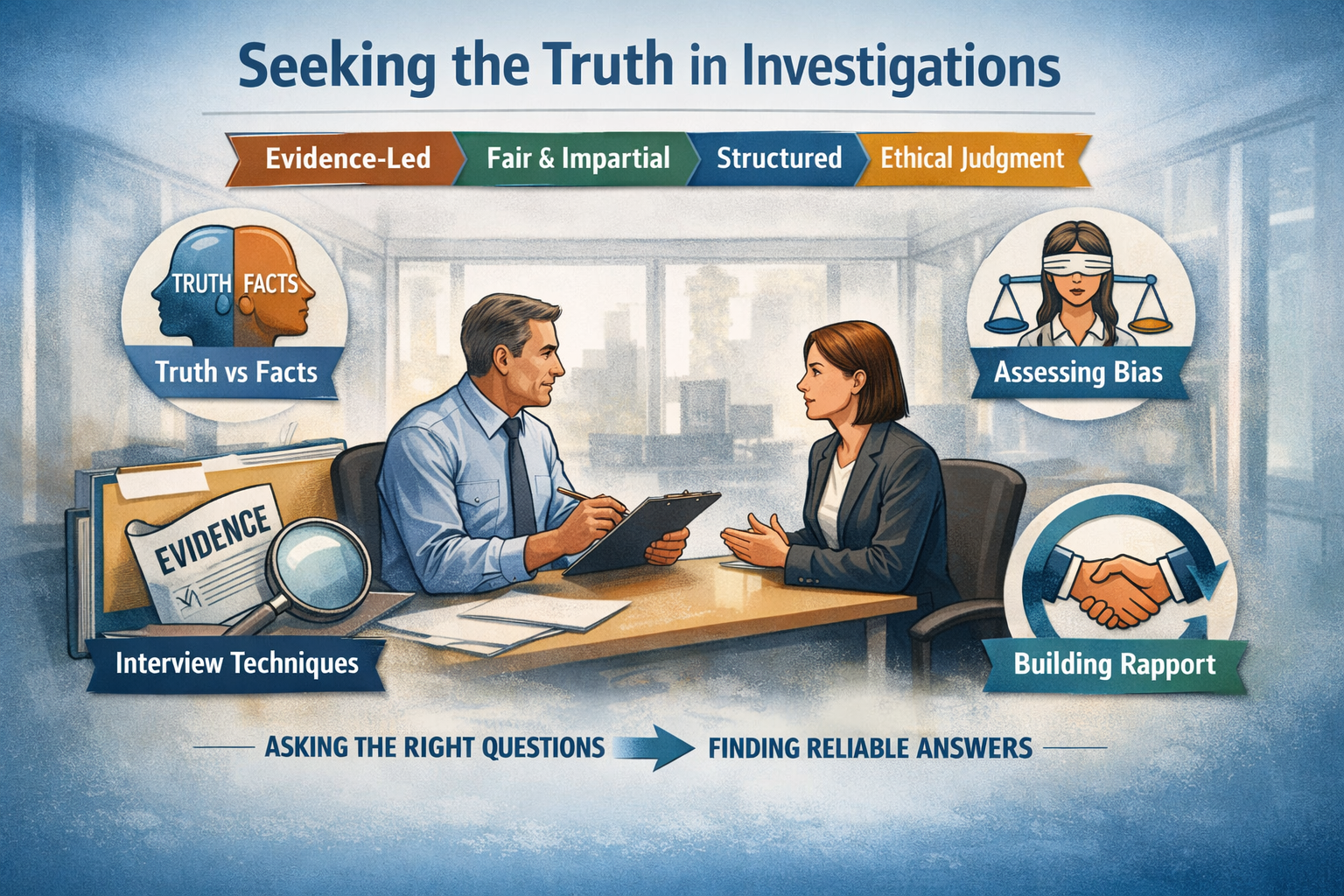
A critical starting point for any investigator is understanding the difference between truth and facts. Truth is subjective. It is shaped by perception, memory, belief, and emotion. Facts are matters that can be independently verified and supported by evidence.
The purpose of an investigative interview is not to decide who seems credible or persuasive, but to get information that can be tested against documents, records, digital data, and other corroborative material. Interviews support fact-finding; they do not replace it.
Interviews vs Interrogations in Workplace Investigations
Most workplace and regulatory investigations rely on information-gathering interviews, not interrogations. Information-gathering interviews are non-accusatory and exploratory. They get accounts, clarify issues, and identify evidence.
Interrogations are accusatory and are traditionally associated with law enforcement contexts where coercive powers exist. Applying interrogation-style techniques in workplace investigations — particularly where employment consequences are involved — can undermine procedural fairness, voluntariness, and evidentiary reliability.
Understanding this distinction is essential before selecting any interview method.
Overview of Common Investigative Interviewing Models
Modern investigators have access to a range of interview techniques. Each serves a different purpose and carries different risks.
The REID Method
The REID Method is a well-known accusatorial interrogation framework developed in the United States. It relies heavily on behavioural analysis and psychological persuasion to elicit admissions.
While historically influential, the REID Method presents significant risks in workplace and regulatory investigations. Its accusatory nature, reliance on behavioural cues, and focus on confessions may undermine procedural fairness and increase the risk of unreliable admissions, particularly for vulnerable interviewees.
Its direct application is generally unsuitable in Australian workplace investigations.
Wicklander-Zulawski (WZ) Method
The Wicklander-Zulawski method evolved from the REID tradition but tries to moderate its more confrontational elements. It emphasizes rapport, behavioural baselining, and strategic questioning.
WZ is sometimes used in loss prevention and fraud investigations where admissions may be sought. However, it remains persuasion-oriented and relies on behavioural interpretation, which can be subjective and unreliable if not carefully controlled. Any admissions obtained must be demonstrably voluntary and corroborated by independent evidence.
The PEACE Model of Investigative Interviewing
The PEACE model is a non-accusatory, information-gathering framework developed in the United Kingdom. It focuses on Planning and Preparation, Engage and Explain, Account, Closure, and Evaluation.
PEACE strongly emphasizes neutrality, open questioning, and structured reflection. It is widely regarded as best practice in workplace and regulatory investigations because it aligns closely with procedural fairness, ethical standards, and evidentiary reliability.
Motivational Interviewing
Motivational Interviewing is a collaborative, person-centred approach originally developed in behavioural change contexts. In investigations, it can be useful where misconduct arises from poor judgement, pressure, or ethical drift rather than deliberate wrongdoing.
MI focuses on reducing resistance, exploring ambivalence, and encouraging candid disclosure without confrontation. However, it is not a substitute for evidence gathering and is less effective where interviewees are deliberately deceptive or legally advised.
Structured Interviewing
Structured Interviewing relies on pre-planned questions asked in a consistent sequence across interviewees. It is useful where multiple witnesses or respondents occupy similar roles or where consistency is critical.
This approach enhances defensibility and transparency but can be overly rigid if applied as a script rather than a framework. Skilled investigators balance structure with flexibility.
Cognitive Interviewing
The Cognitive Interview is an evidence-based technique designed to improve memory recall, particularly for witnesses. It uses techniques such as context reinstatement and free narrative recall to increase the quantity and accuracy of information obtained.
While highly effective for cooperative interviewees, cognitive interviewing is time intensive and less suitable for hostile or deceptive subjects.
Kinesic (Behavioural Analysis) Interviewing
Kinesic interviewing focuses on interpreting verbal and non-verbal behaviour as indicators of credibility or deception. While behavioural cues may provide contextual awareness, research consistently shows they are unreliable as indicators of truthfulness.
Over-reliance on behavioural interpretation increases the risk of confirmation bias and flawed conclusions. Best practice treats behavioural cues as prompts for further inquiry, not proof.
Strategic Use of Evidence (SUE)
The Strategic Use of Evidence is an evidence-led approach that focuses on when and how evidence is disclosed during interviews. Rather than confronting interviewees early, evidence is introduced gradually to test explanations and identify inconsistencies.
SUE strengthens defensibility by reducing reliance on demeanour and increasing reliance on corroborated facts. It is particularly effective in fraud, corruption, and misconduct investigations involving documentary or digital evidence.
The Importance of Rapport in Investigative Interviews
No matter the interview method used, rapport is critical. Rapport does not mean friendliness or agreement. It means establishing a professional environment in which interviewees feel respected and willing to engage.
Rapport improves cooperation, recall, and information quality. However, it must remain professionally bounded. Over-familiarity or perceived alignment can undermine objectivity and expose investigations to challenge.
Selecting the Appropriate Interview Method
There is no single “right” interview technique. Choice should be guided by:
- The seriousness of the allegations
- The role of the interviewee
- Available evidence
- Legal and organisational risk
- Vulnerability considerations
In most workplace investigations, information-gathering approaches such as PEACE, Structured Interviewing, Conversation Management, and SUE provide the strongest balance of fairness and defensibility.
Risks of Misapplying Interview Techniques
Misapplication of interview methods is a common cause of investigative failure. Confirmation bias, premature assumptions of guilt, behavioural over-interpretation, and poorly timed evidence disclosure can all contaminate outcomes.
Investigators must understand not only how interview models work, but when not to use them.
Conclusion: Judgement Over Technique
Investigative interviewing is not about mastering techniques; it is about exercising judgement. Models provide structure, not answers. Evidence provides certainty, not intuition.
Investigators who remain evidence-led, fair, and adaptable are best placed to reach conclusions that withstand scrutiny and maintain organisational trust.