

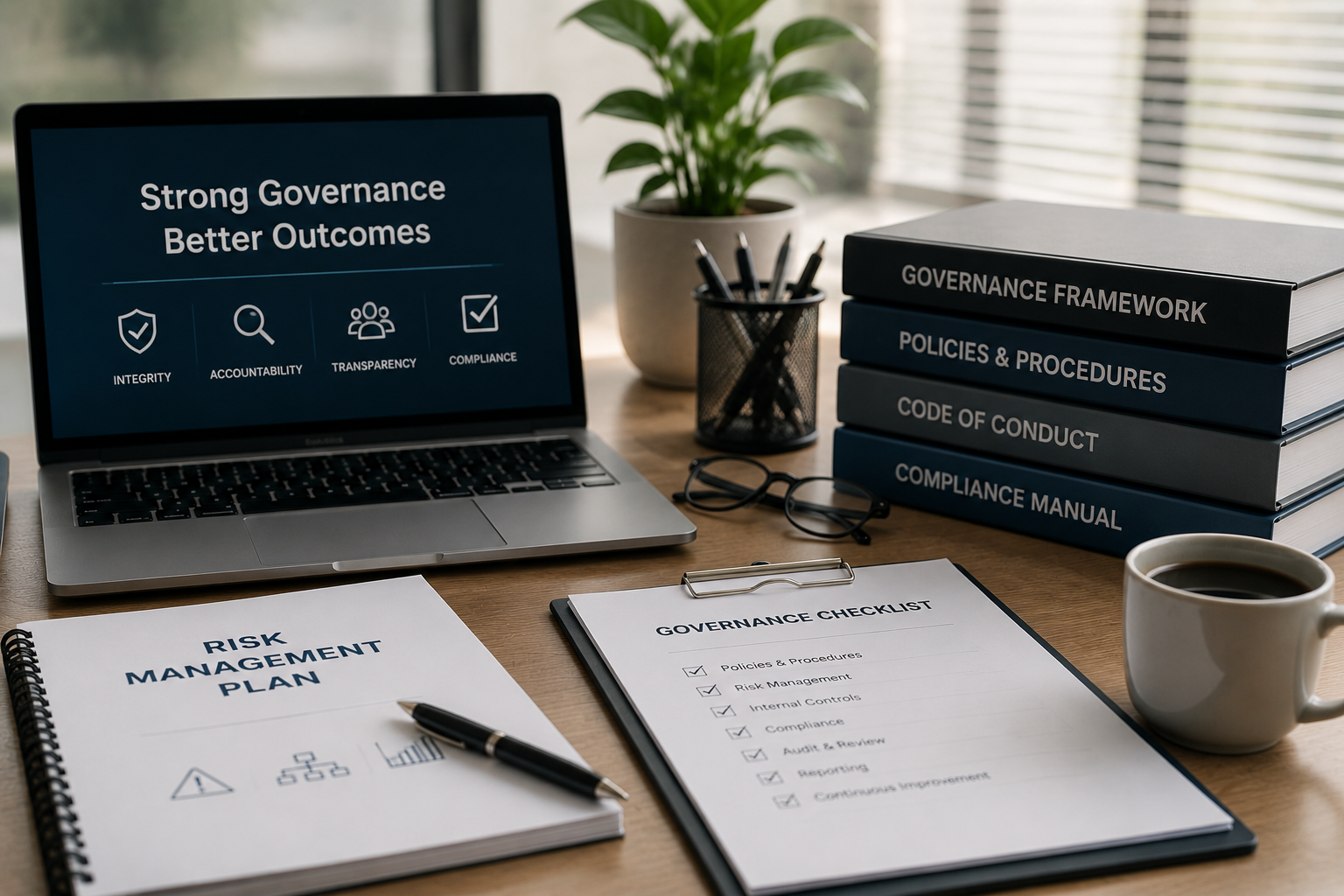
Governance Matters — Especially When Nobody Is Watching
Governance Looks Strong on Paper — But Is It?
Today, most organizations publicly champion governance, compliance, and accountability.
They publish policies, codes of conduct, procurement procedures, fraud control frameworks, workplace behaviour standards, and risk management plans. Boards and executive teams routinely tackle integrity, transparency, and compliance obligations.
Despite these efforts, governance failures persist across Australia.
By 2026, policies are rarely the problem. The problem is whether those policies are truly understood, consistently applied, properly enforced, and backed by leadership behaviour.
Many organizations seem compliant outwardly, while serious problems silently brew beneath.
This remains a top governance risk for councils, government agencies, and SMEs.
Why Governance Failures Still Occur in 2026
Modern organizations navigate ever-tougher environments.
Councils and government departments confront:
- rising community expectations
- tighter financial pressures
- increasing regulatory obligations
- workforce shortages
- cyber security threats
- procurement scrutiny
- heightened public accountability
SMEs face these common challenges:
- rising operating costs
- staffing pressures
- economic uncertainty
- increasing compliance obligations
- intense commercial competition
Under pressure, organizations can slowly normalize poor practices.
Shortcuts may replace proper processes. Oversight can weaken. Employees may avoid reporting concerns out of fear of conflict, reputational damage, or career repercussions.
Importantly, governance failures seldom start with major misconduct.
They often start with small rationalizations:
- “we need to get this project finished.”
- “everyone does it this way.”
- “it’s only temporary.”
- “the organization cannot afford delays.”
Repeated compromises eventually erode accountability, transparency, and organizational integrity.
Performance Pressure and Ethical Risk
A top governance risk in 2026 is performance pressure.
Many organizations intensely focus on:
- financial performance
- project delivery
- operational targets
- KPIs
- political expectations
- public image
While performance matters, problems arise when organizations prioritize outcomes over ethical decisions and proper oversight.
This can foster environments where employees feel pressured to:
- manipulate reporting
- ignore compliance failures
- bypass procurement controls
- avoid documenting concerns
- conceal mistakes
- protect reputations instead of addressing problems
In many investigations, warning signs appeared well before formal action.
The failure was not because of lack of information. The failure was the unwillingness to confront the problem early.
Why Councils and SMEs Remain Vulnerable
Local Government Risks
The failure was the unwillingness to confront the problem early.
- public funds
- procurement processes
- development approvals
- community services
- infrastructure projects
- regulatory functions
Even the perception of favoritism, poor transparency, weak procurement controls, or inconsistent decisions can erode community confidence.
Public trust is hard to earn and easy to lose.
Poor governance also exposes councils to:
- reputational damage
- regulatory scrutiny
- legal disputes
- workplace conflict
- adverse media attention
- loss of community confidence
SME Risks
SMEs face distinct yet equally serious governance challenges.
Smaller organizations often depend on trusted staff, informal systems, and minimal oversight.
Without strong internal controls, businesses risk becoming vulnerable to:
- procurement manipulation
- payroll irregularities
- fraud
- conflicts of interest
- financial misconduct
- cyber-related scams
- poor record keeping
In many SMEs, governance weaknesses are not deliberate. They develop gradually because operational pressures take priority over oversight.
Warning Signs Leaders Often Ignore
They develop gradually as operational pressures overshadow oversight.
Common indicators include:
- resistance to scrutiny
- poor record keeping
- inconsistent decision-making
- weak procurement controls
- lack of policy enforcement
- repeated complaints about transparency
- employees afraid to report concerns
- senior staff avoiding accountability
- excessive reliance on one employee controlling key functions
- unexplained financial anomalies
- informal approval processes
- poor complaint handling
Organizations must take these indicators seriously.
Unaddressed small issues can escalate into major organizational, financial, and reputational risks.
Governance Is More Than Compliance
Strong governance isn’t about the number of policies an organization has.
It is measured by:
- leadership behaviour
- accountability
- transparency
- ethical decision-making
- effective oversight
- consistent policy enforcement
- willingness to address misconduct
- organizational culture
Policies alone don’t build integrity. Leadership behaviour does.
Leadership behaviour delivers.
When leaders dodge tough talks, skip consistent standards, or put reputation over accountability, organizational culture can quickly decay.
Building a Culture of Accountability
Organizations that manage governance risks effectively share key characteristics.
They:
- encourage reporting of concerns
- respond to complaints consistently
- maintain strong procurement and financial controls
- review policies regularly
- provide ongoing staff training
- support independent oversight
- act early when warning signs emerge
- prioritize transparency and accountability
Strong organizations know governance is not a onetime exercise.
Governance demands constant focus, regular review, and strong leadership commitment.
Final Thoughts
Governance failures continue to harm councils, government agencies, and SMEs across Australia.
The lesson is obvious.
A policy on a shelf offers little protection without a culture of integrity, accountability, transparency, and ethical leadership.
Real governance is not about appearances.
It is about what leaders, managers, and employees do when no one’s watching.
Contact [email protected] for help in these areas.