
$90,000 Sexual Harassment Case: A Warning for Councils and Small Businesses
$90,000 Sexual Harassment Decision – What Council CEOs and SME Managers Must Learn From This Case
A recent Federal Circuit and Family Court decision has sent a very clear message to employers across Australia: failing to properly manage workplace sexual harassment and basic employment obligations can be extremely costly — both financially and reputationally.
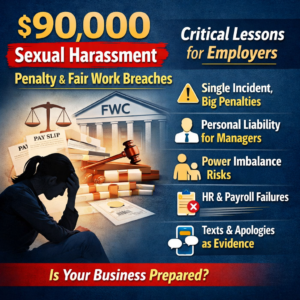
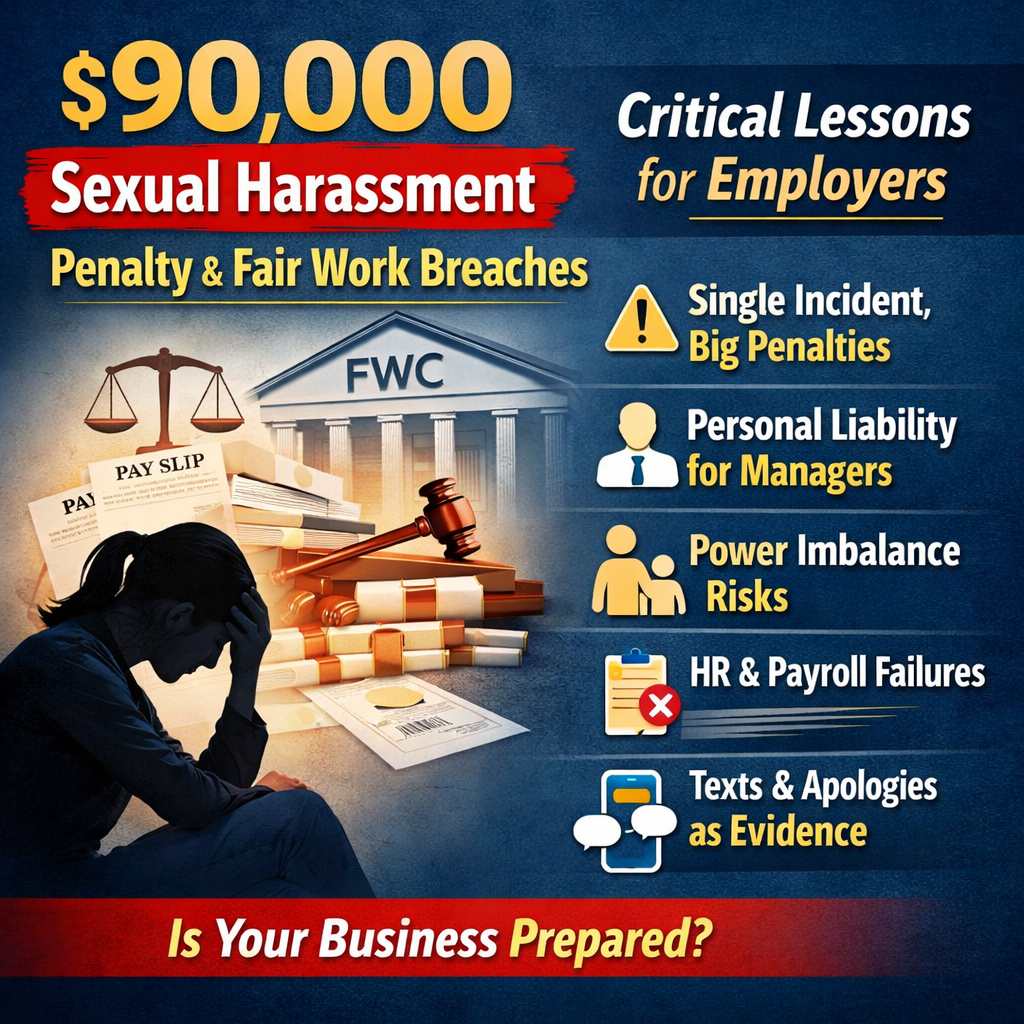
In Mejia v Capital City Café-Bar [2026], the Court ordered a café director to pay approximately $90,000 in compensation and penalties following a sexual harassment incident involving a young employee. This case is significant because it is one of the first published decisions under the new sexual harassment jurisdiction introduced under the Fair Work Act reforms in March 2023.
For Council CEOs, senior managers, and SME owners, this case provides several critical lessons.
What Happened in This Case?
The employee, a 23-year-old migrant worker, alleged that the café director hugged her, kissed her without consent, and attempted to offer her money while pinning her against a sink.
The incident occurred shortly after the employee had raised concerns about her pay and the fact that she had not been receiving pay slips. The employee did not return to work after the incident and later commenced legal proceedings.
The Court accepted that the incident caused distress, humiliation, and ongoing emotional impact, and compensation was awarded accordingly.
However, the sexual harassment itself was only part of the problem.
The Employer’s Bigger Problem – Multiple Fair Work Breaches
What significantly increased the penalties was the employer’s broader failure to comply with basic employment laws. The Court found the director had failed to:
- Provide a Fair Work Information Statement
- Provide a Casual Employment Information Statement
- Provide pay slips
- Pay correct wages including overtime and casual loading
- Maintain proper employment records
- Make the Award and National Employment Standards available
- Provided false pay slips to the Fair Work Ombudsman
The Judge described this as a “comprehensive, if not complete, disregard for the obligations of a national system employer.”
This is a critical point for employers: sexual harassment cases often expose broader compliance failures.
Important Legal Development – New Sexual Harassment Jurisdiction
This case was brought under section 527D of the Fair Work Act, introduced under the Secure Jobs, Better Pay reforms.
This means employees now have another legal pathway to pursue sexual harassment claims — in addition to the Human Rights Commission and anti-discrimination processes.
In practical terms, this increases the legal risk for employers.
Key Takeaways for Council CEOs and SME Managers
A Single Incident Can Result in Large Compensation
The Court made it clear that sexual harassment does not need to be repeated behaviour to result in significant damages.
Many managers still believe that a “one-off incident” is less serious.
This case confirms that is not how courts see it.
Power Imbalance Matters
The Court placed significant weight on:
- The employee being young
- Being a migrant
- Having limited financial resources
- The offender being the business owner and in a position of authority
This highlights a major risk area for:
- Small businesses
- Councils
- Family-run businesses
- Workplaces where owners/directors deal directly with staff
Power imbalance increases damages.
Poor HR Practices Will Make Everything Worse
The penalties were not just for harassment — they were for systemic non-compliance.
This is where many councils and SMEs are exposed:
- No proper policies
- No training
- Poor documentation
- Incorrect pay slips
- No investigation procedures
- No HR systems
- No external investigator
When something goes wrong, these failures compound liability.
Text Messages and Apologies Can Become Evidence
The director sent messages apologising and asking the employee to keep the incident secret.
This significantly damaged his case.
Managers and business owners often try to “fix things informally” after an incident.
This can make the legal situation worse.
This Case Sends a Message About Personal Liability
Importantly, the director personally was ordered to pay penalties.
This is critical for:
- Council senior managers
- Directors
- Business owners
- CEOs
- General Managers
You can be personally liable, not just the organisation.
What Organisations Should Do Now
This case clearly shows what organisations should have in place:
- A clear sexual harassment policy
- Complaint reporting procedures
- Investigation procedures
- Manager training
- Proper wage and payroll compliance
- Proper employment records
- Access to an external investigator
- Post-investigation follow-up processes
Organisations that do not have these systems are exposed to significant risk.
Final Thoughts
This decision is a warning to employers across Australia. The combination of sexual harassment and basic employment law breaches resulted in a $90,000 outcome for a single incident involving one employee in a small business.
For councils and SMEs, the message is very clear:
If you do not have proper workplace policies, complaint procedures, and investigation processes in place before something happens, it is already too late.
Prevention, proper procedures, and independent investigations are no longer optional — they are a critical part of risk management and governance.